

Highlights
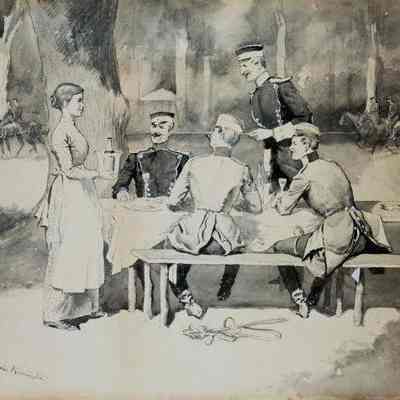
A Jolly Party by the Wayside
ink drawing of German soldiers eating at an outdoor garden. 3 soldier sit at long table and one soldier is standing. They are all looking at a woman standing at the ned of the table. she wears a long apron over her dress and is holding a container with a bottle inside. Men on horses ride in the background.
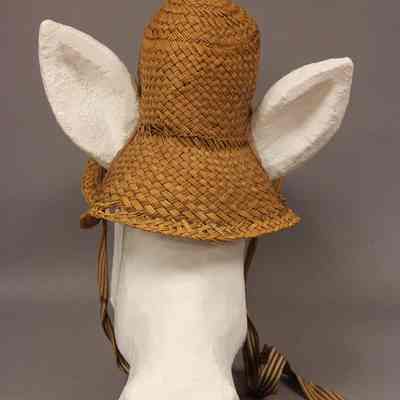
Animal Hat
One straw animal hat, likely for a horse. The hat has two holes cut for ears, with a brownish fabric binding sewn around the openings. Two long, brown and white striped fabric ties are sewn to the brim. The hat is bent from poor storage.
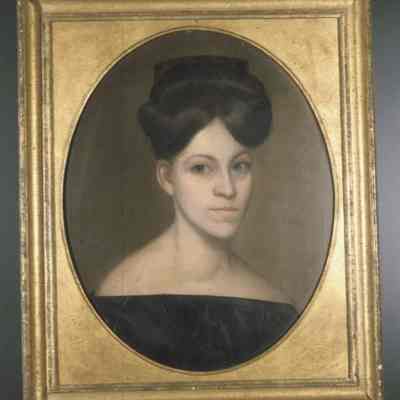
Ann Maria Failing
Oval portrait of Ann Maria Failing, a young woman with a comb in her "done-up" brown hair. Black dress has low, straight neck-line. Background color is brown-tan. Molded frame of gesso and gold leaf and with an oval gilded inset (mat) also molded. In pencil on back of panel: "PAINTED BY MR. PALMER, 1827 CANANDAIGUA"
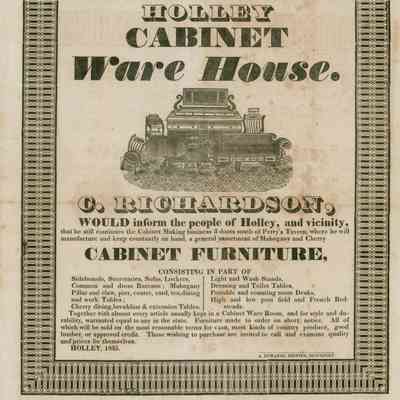
Broadside, "Holley Cabinet Ware House"
This broadside advertises Chase Richardson's cabinetmaking business, and reads, in part: Holley / Cabinet/ Ware House. / C. Richardson / would inform the people of Holley, and vicinity, / that he still continues the Cabinet Making business 3 doors south of Perry's Tavern..." Printed in various sizes and styles of type, with a central composite image of period furniture, including a dresser, paint fancy chairs, Grecian settee, a washstand and tilt-top table. The text within a thick ornamental border.
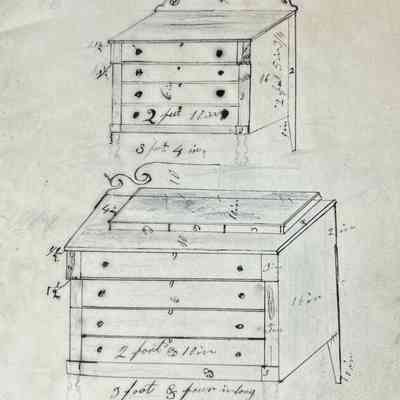
Cabinetmaker's Design Book
A cabinet maker’s notebook/sketchbook is quarter bound in fine brown calfskin with covers of cream, brown, and blue, marbled paper. Original binding. On the front endpaper written in light pencil it says “Chase Richardson, Sandy Hill, NY, 1832”. The inside pages are filled with drawings of various furniture rendered in both pencil and ink. Furniture is drawn with all measurements notated and most have titles stating the name of the item and the style. In some drawings different options are shown such as different styles of furniture legs and some drawings have prices listed. There are pages filled with designs of patterns that could be carved into the furniture. In the back of the notebook there are more than a dozen extremely detailed recipes for various finishes that have been attributed to the cabinet makers who created the recipe. The recipes are in different hands, possibly the creators of the recipe wrote it in his notebook for him. Various dates throughout are listed from 1830-1833.
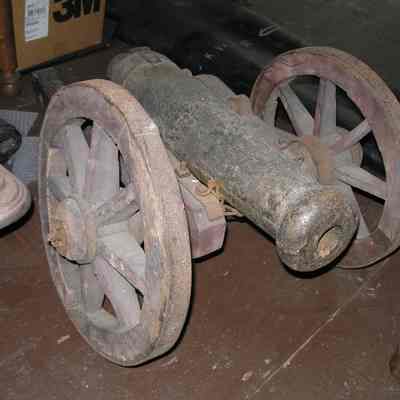
Cannon
The cannon has a cast-iron tube 24 inches long, with bore approximately 1-5/8 inches. There is a heavy cascabel at the breech and a pronounced muzzle swell of short-radius semicircular profile. The trunnions, which are cast integral with the tube, are on the center line, and there is a cast pan for a priming charge and a rudimentary ring-shaped reinforce. The tube is mounted in a small wooden field carriage, 26 1/2 inches long, with wooden wheels 15 3/4 inches in diameter. Hubs, spokes and felloes are all wood; there are thin iron reinforcing bands on both sides of each hub, and thin iron tires that have been forge welded into a continuous circle. One cheek of the carriage has been broken long ago and reinforced with an iron strap bolted on. The tube is a sand casting, showing a definite mold separation line parallel with the bore, running forward from the flash pan. The interior, now eroded, shows no evidence of having been bored after casting.
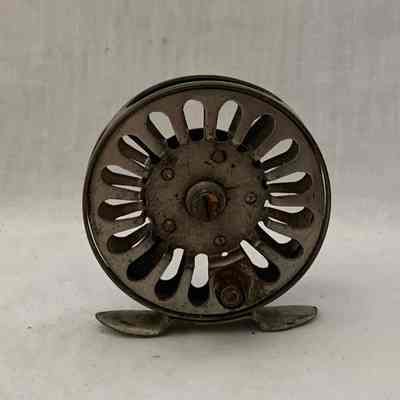
Case, Rod and Reel
One cloth rod and reel case designated 'f' containing a fishing rod (4 parts) 'a', 'b', 'c' and 'd' and a reel designated as 'e'. The Fly rod is a Nick . "JUDSON & CO"; The reel is marked: "NO - 3 " "PAT APR 26, '87" On yellow paper scotch taped to case "SETH GREEN/GAVE/THIS LANCEWOOD FLY ROD/TO CHAS DUDLEY TUKE/HANDS/OFF!! The words "MUSEUM PIECE" are encircled. Mr. Tukes grandfather was a friend of Seth Green. In total there are 6 pieces sub lettered from 'a' through 'f'. (Case and reel are missing 9/01.) Reel found 4/2012 rod and case missing
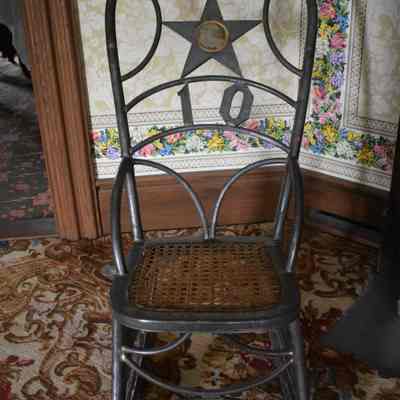
Chair, Rocking
A tinplated rocking chair, made of tin with tubular construction on the back. Designed in celebration of a 10th wedding aniversary with an inscription on the star on the back. On the back of the chair is a star, underneath the star is the number "10". On the left side below the seat is stencilled "75", On the right side, "65". Within the tin star and covered with Isinglass: "Present to/Mr. and Mrs. A. Parker/ May 10th 1875/By/T.D. Brown"
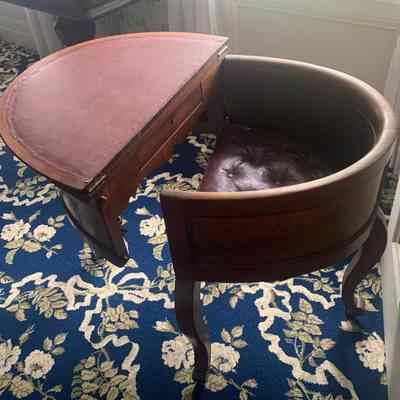
Chair-Table
A convertible chair which can be made into a table, desk or chair. It consists of an oval table with cabriole legs on casters and deep panelled skirt with two bands of wavy molding. When the top is folded back and brass fittings are unlocked, leather upholstered chair may be pulled out to form a writing desk and chair. One drawer. Separate tufted leather pad on chair. Small oval brass plate with: "HEDGES/APRIL 1854/PATENT".
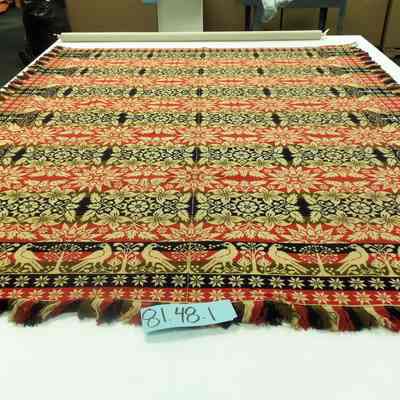
Coverlet
Jacquard-woven coverlet. Brick/olive/indigo/ natural with birds, fruit trees and geometric motifs with acorns.
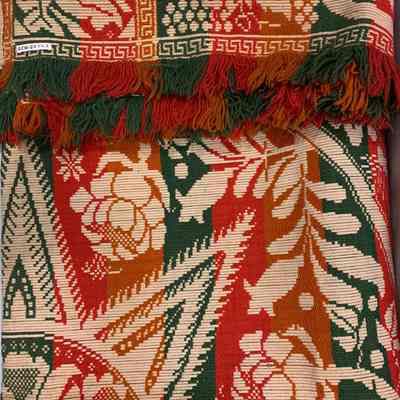
Coverlet
Jacquard-woven coverlet. Orange, red, green, natural with wool fringe in red, orange, green. Sunburst in center. Meandering floral foliage design from cross hatched pots in the corners. Undulating band on border running through foliage and grapes. Greek key bands around this border. Beiderwand weave with free areas.
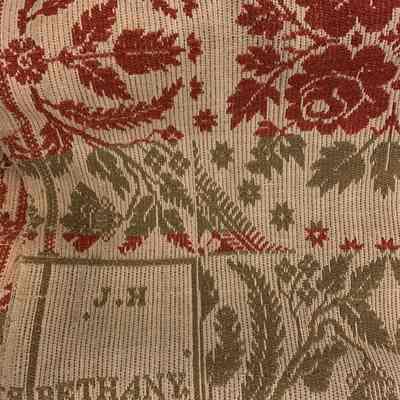
Coverlet
Jacquard-woven coverlet. Red, green and white.
Cradle
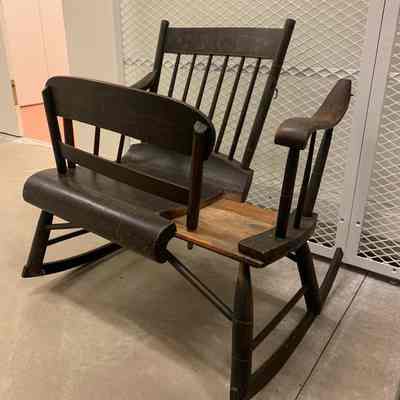
Convertible, Sheraton style six-spindle Boston cradle/rocker painted black with red graining and simple harp. Top two slats are removable as one piece; the left side of the chair seat pulls out, complete with the three-spindle scroll arm. Once the seat is enlarged by this 8 1/16", the removable top of the chair fits into two holes on the front of the scroll seat, creating a cradle. Stencil in black on bottom of seat: "S.S. MAY/ PATENT JUNE 4, 1850".
Dress
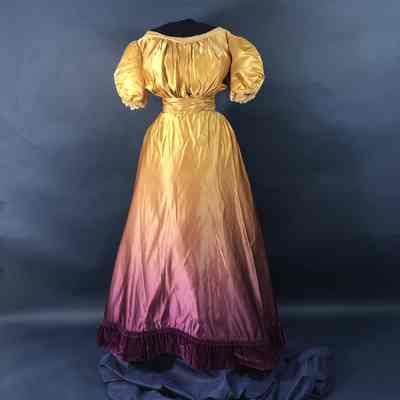
2-piece dress with petticoat. Bodice (a) - made of silk satin with gathered mono-bosom pigeon breast front. Puffed short sleeves trimmed in small gathers of cream silk voile. Silk voile trimming across wide scoop neckline. Waist has a horizontal bands of satin silk, slightly gathered. Center back closes with hook and eye. Some eyes are fabric, some are metal. Tension-closure hooks labelled "Cholls". Velvet magenta rosettes (three) close back waist band. Lined completely in silk ivory taffeta. Seven vertical bones across waistband, which is lined with a thick cotton twill in light brown. Taffeta ties at center back and center front neckline. Skirt (b) - ombre silk satin; made of 8 panels. Center front has two darts and lies flat while 7 back panels gathered in three rows of gathers. Unlined. Deep purple velvet flounce at hem, faced with shot twill matching ombre colors. Center back snap closure with hooks and eyes to attach to bodice; seams left unfinished. Petticoat (c) - made of silk taffeta in ivory. Four gored panels with two gusset inserts at hem. Knife pleats 9" deep hem, which are very dense. Darted around waist - no pleats or gathers. Machine-stitched. Hook and eye closure at the center back; unfinished interior seams. Petticoat is stored in a different location. Boxed, on Shelf 1 [Bay 217: Storage Room 2: John L. Wehle Gallery].
Erastus and Julia Hyde
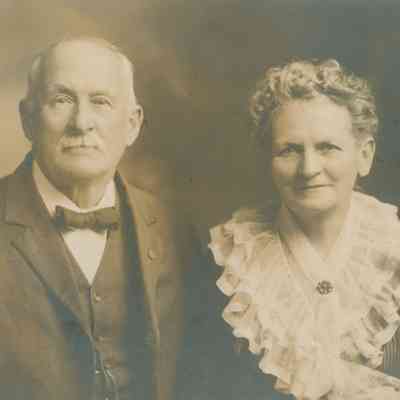
One photograph of Erastus and Julia Hyde. Erastus is wearing a three-piece suit with a bow tie, and there is a pin on his lapel and a watch chain is visible on his vest. He is balding, with a moustache. Julia is wearing a dress with striped fabric down the front, solid colored sleeves and a large, ruffled fichu that is pinned (looks like pearls in the pin). Her hair is up, with small waves/curls. The background is plain.
Hammered Dulcimer
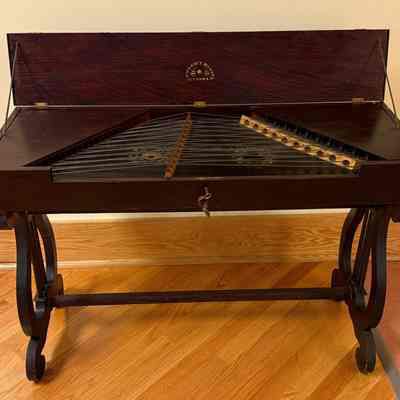
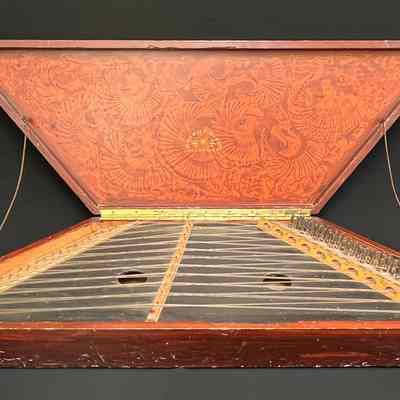
One hammered dulcimer, sometimes called a hammer dulcimer, set into a lidded case, with a craved wooden stand. The case has a hinged top with two cords on each side to keep it propped open. Two triangular panels on each side of the top can be removed to gain access to the pegs and storage compartments. On the right side there are 12 sets of 4 raised iron pegs alternating with 11 sets of 3 iron pegs, which have wire stings that are attached to small raised studs on the other side. There is a black painted sounding board with two circular resonator holes, both of which have a gold floral motif painted around them. One has a gold wooden insert with a spiral pattern carved into it. One bridge, pierced with circular holes, is situated to the left of center, and another is on the far right. The following words are stenciled in gold on the underside of lid: “P. Wight, Maker / Alabama, NY ". Includes 1 hammer, one tuner, and 1 key along with extra strings.
Hammered Dulcimer
One hammered dulcimer, sometimes called a hammer dulcimer, constructed from painted pine in a trapezoidal case. Painted and grained on inside cover in flowing shell designs. The case is hinged with two cords on each side to keep the propped open. On the left side there are 12 sets of 4 raised iron pegs alternating with 11 sets of 2 iron pegs. The side panels have a clear finish, as do the flank and the sounding board. An iron rod is inset on the edge of the left maple panel and protects the wood from the strings. There is a black painted sounding board with two circular resonator holes. One bridge, pierced with circular holes, is glued almost perpendicular to the front. Another is on the far right. The following words are stenciled in gold on the underside of lid: “P. Wight, Maker / Alabama, NY ". Includes 2 hammers and one tuner.
In a Tight Place
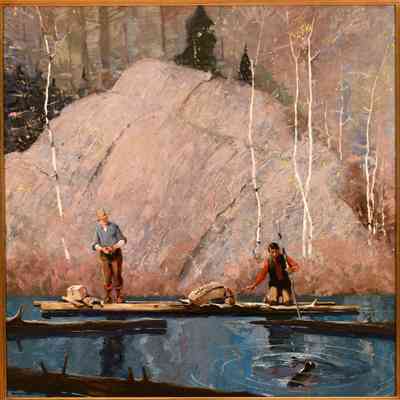
Fisherman stands on a raft reeling in a fish while guide kneels; net in right hand waiting to net fish. A fish is in the foreground, dorsal fin out of the water, but is swimming between 3 logs forming a triangular shape. There is a large coulder behind the men and 7 thin Birch trees stand in front of the boulder. The guide is probably Native American. He has dark toned skin and wears red shirt common to guides. The scene probably depicts Canada where Mason liked to fish.
Julia Hyde Letter
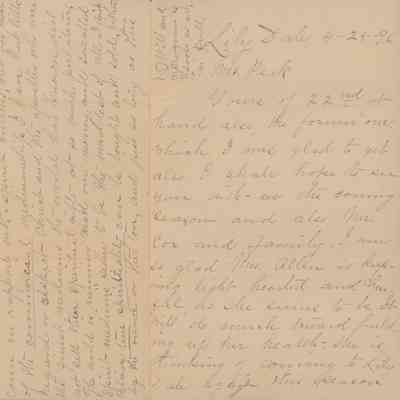
Letter from Julia E. Watson Hyde to Mary Arabella Peck, wife of Frederick A. Peck. Mary and Frederick were first cousins and both were distant cousins of Henry Jones Peck of Jones Farm which sits on the property of the GCV&M.
Jump Rope
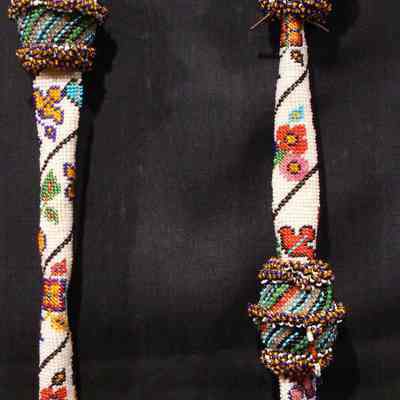
Jump rope made of knitted beads, with a pair of large beaded 'knobs' defining the handles. White opal bead ground with black-bordered diagonal stripe spiraling around the 'rope.' Geometric and stylized flowers and hearts in bold colors. Some metallic copper and gunmetal colored beads (speculated to be glass). Knobs have black, green, turquoise, and clear diagonal stripes with accent bands of short loops of dark yellow, cobalt, black, and white beads.
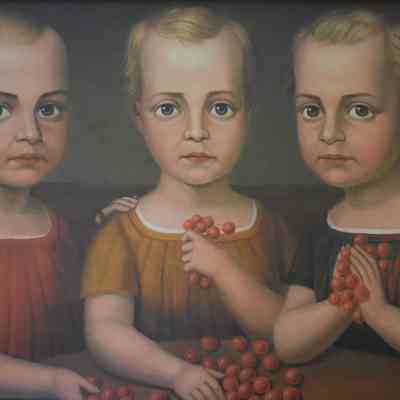
Long Triplets
Portrait of triplets, Joe, Martin and William Long, born in Salina, NY, in March 1854. They are seated at a table handling cherries (there was a cherry orchard behind the Long home in Vesper
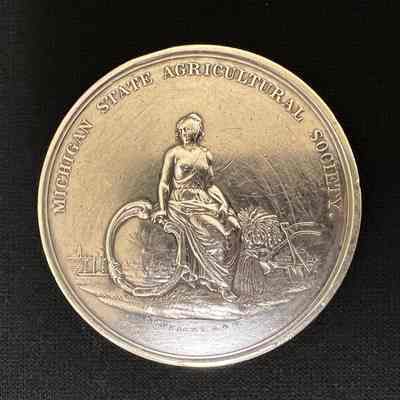
Michigan State Agricultural Society Medal
Michigan State Agricultural Society Medal. (Front) Features a woman dressed in a toga sitting among agricultural devices and sheaves of wheat with a harbor view in the background. Top of coin reads "Michigan State Agricultural Society". (Back) Inscribed: "To J. F. Gordon Co. For self raking binding harvester At The 20th Meeting 1868". Top of coin reads "Michigan State Agricultural Society" and bottom reads "Organized March 24th 1849." Made of silver.
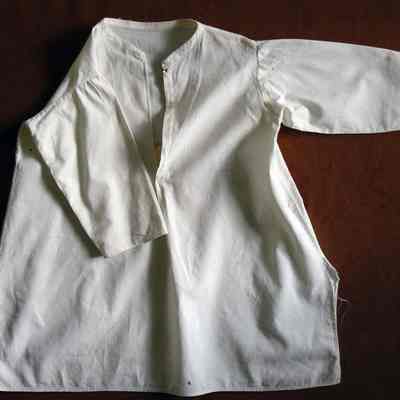
Nightshirt
Little boy's nightshirt made of white PW cotton. Hand-stitched except for the armscyes and the bottom hem. Long straight sleeves with simple narrow hems. No gussets, or reinforcements. Flaring body with side seams, vents, and straight hem. Front placket opening with little pleat at the base, faced, as is the neck opening. One buttonhole at the top. It is speculated the maker could have machine-stitched the hems first, installed the flat sleeves, and then finished assembling it at the wearer's side.
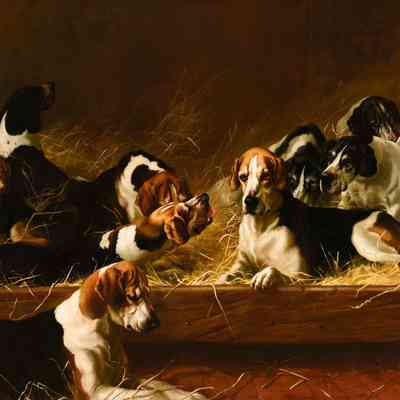
Old Benchers
Finely detailed image of ten English foxhounds and one terrier resting on their kennel bench. One hound is lying on the floor in front of the bench while the rest are lying or sitting on the bench. A hound on the left side of the painting is exchanging looks with the terrier. The terrier has a drop of drool spilling from its mouth as does the hound lying on the bench directly above the one on the floor. The dogs are finely detailed, and you can see the wrinkles, muscles and bony knuckles and shoulders. The dog's fur is detailed with tiny brush strokes. The straw in front is bright and golden yellow, then fades away too dark in the background.
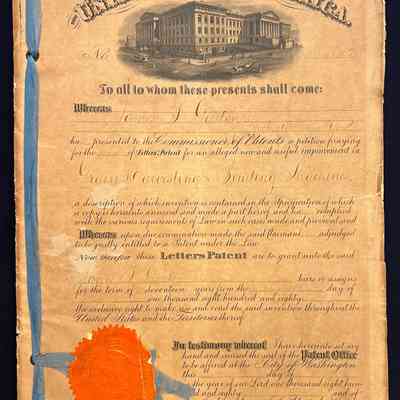
Patent
One US Patent issued to James F Gordon for a Grain Harvesting and Binding Machine, May 1886.
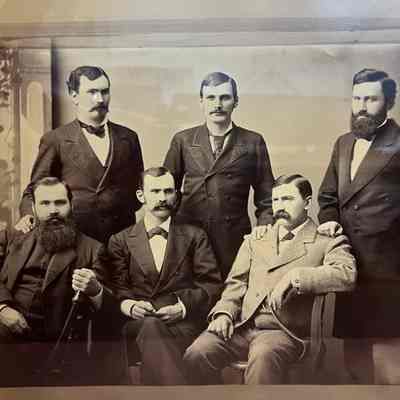
Photograph of Six Gordon Brothers
Photograph of six Gordon brothers. Back row (L-R) George Donaldson Gordon, Edward Young Gordon, John Henry Gordon. Front row (L-R) James Fraser Gordon, Alexander Gordon, Angus Cameron Gordon. James Fraser Gordon was the creator of "The Gordon Self Raking and Binding Harvester", patented May 12, 1868. We have a model of the Harvester in the GCV&M collection, as well as the patent and medal it won.
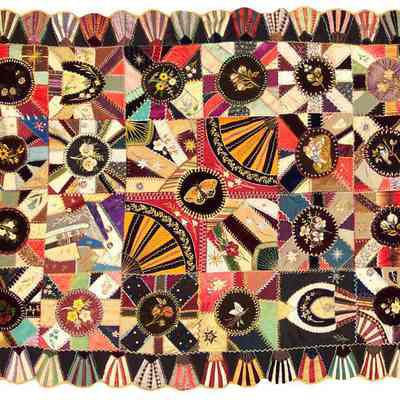
Quilt
Crazy quilt made with polychrome silks, velvets and beads, each joined with embroidery stitches.
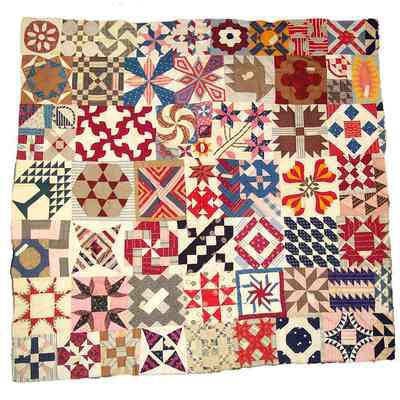
Quilt
Applique and piecework; pattern names written on paper and sewn on sampler; list of the patterns used is attached; top only.
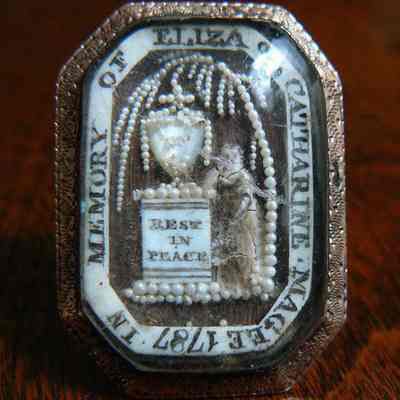
Ring, Mourning
Mourning ring for Eliza Catherine Magee
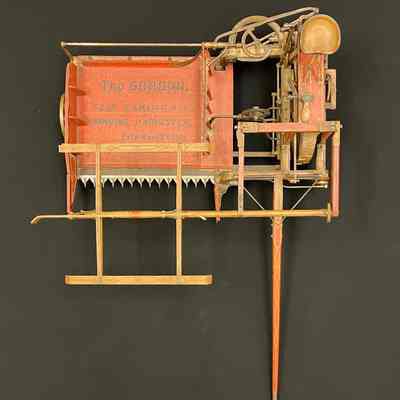
Salesman's Model of Harvester
A salesman's model of " The Gordon Self Raking and Binding Harvester". Patented May 12, 1868 by James Fraser Gordon.
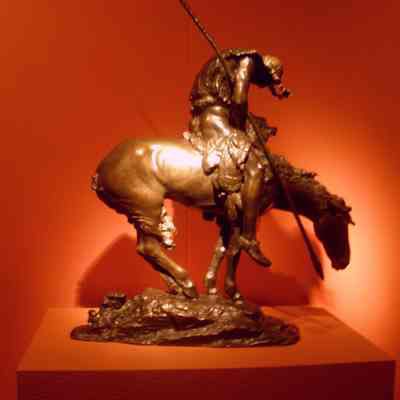
The End of the Trail
Oval base, roughly textured with rocky formation on which stands a horse with head lowered, ears drooping downward, mane falling forward. On horse's back is a realistic 3-D American Plains Indian wearing moccasins, loin cloth and buffalo robe. Upper body is bare, head droops forward, braids fall forward, blowing in the wind. Indian carries a lance in right hand. This is a later version of the 1894 work. The artist changed the braids and the mane in this version to suggest a strong wind blowing from behind. Slightly green patina.
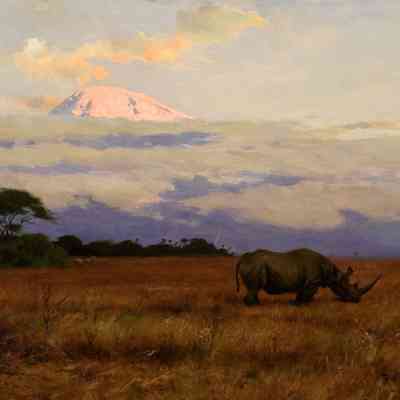
The First Ray of Sun, Kilamanjaro- Rhinoceros
In the background the top of Mt. Kilimanjaro is visible above clouds; a lone rhinoceros stands in an open field of brown grass. Trees and shrubs off to the left in the distance with a few zebras standing beside the trees. In the background, Mt. Kilimanjaro is tinged pink and a few yellow- and cream-colored clouds float above. The rest of mountain is covered with white clouds and only parts of the blue mountain can be seen through the clouds.
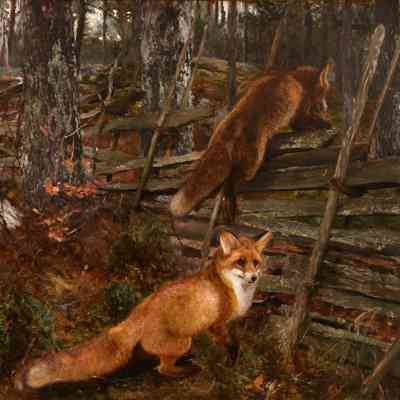
The Foxes
Rustic scene- forest view with a split rail wooden fence. One fox is jumping over the fence and the other fox has paused and is looking a the viewer. Standing fox forms the focal point of the painting. The artist depicted a rounded belly with light colored paint, then tones of brown and red for a luminescent quality.
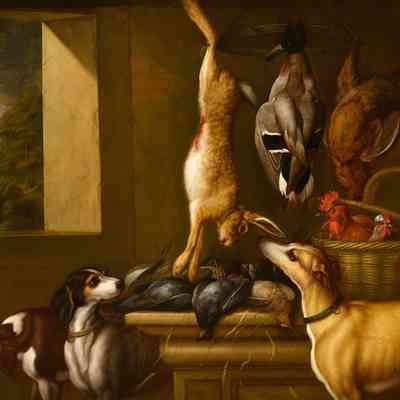
The Game Larder
Still life of dead game in stone game larder with three dogs and basket of live scarlet rooster and chicken. Derived from 17th century Dutch still life school. Painting shows competent use of perspective and realistic detail. Brunette palette. Painting depicts a counter with architectural moldings laden with dead game birds, basket with rooster and chicken. Hanging above is a realistic rabbit, duck and other game bird. To one side and in front of counter are three dogs with collars. On viewer's left is a window with landscape, a cottage and sunset. Window provides light source that illuminates the game.
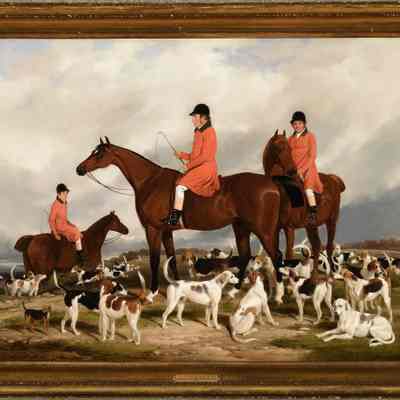
The Old Surrey and Burstow Foxhounds
Hunting scene with a pack of hunting dogs in foreground and in center. Shown in profile is Master of the Hunt, Tom Hills riding Lounger. In the center right, his brother Morris Hills shown on Paddy. On the left, son Peckham Hills on Factor facing right. All riders wear knee length red (pink) frock coats with brass buttons going down coat front with black collars. All wear black and tan riding boots, white breeches, tan gloves, black peaked riding hats and carry riding crops. Each horse is harnessed with red strap across forehead. Scene is set on open heath with trees in distance. Riders are profiled against a blue and grey sky with clouds as background. Artist has naïve sense of prospectus. Realistic, smoothly painted with no visible texture.
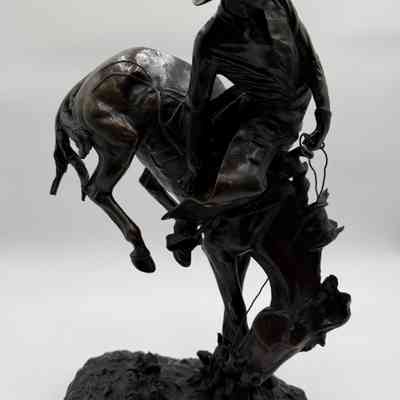
The Outlaw
Oval base with rough textured surface to base and realistic, 3D cast of bucking horse/outlaw balanced on front legs with rear legs in air. Cowboy wearing leather chaps balances on horse in saddle. There is a reign in one hand, cowboy hangs onto the saddle with the other hand. Work has strong silhouette, original brown patina and continual contrast of matte and shiny surfaces. Cast #15
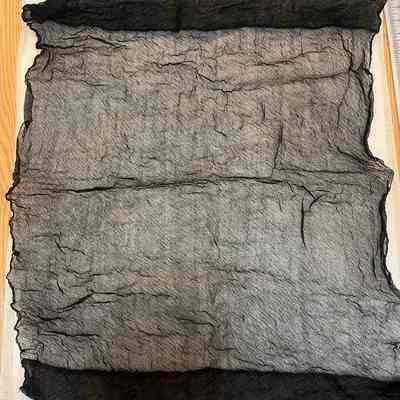
Veil
Lady's black silk crape mourning veil. Rectangular in shape 26"w X 31"l, with deep hems on either end, approx. 3". MUST WEAR GLOVES AND FACE MASK WHEN HANDLING.