

Making Music
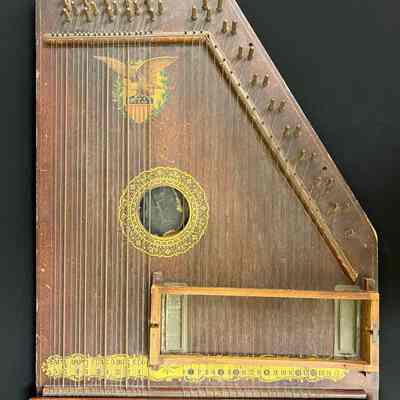
Autoharp
One autoharp with wooden base, wooden pegs and metal tacks holding wire strings at regular intervals; circular hole in center, measuring 2.375 inches in diameter is surrounded by a gold painted border. Narrow end of base has a painted eagle with spread wings standing on a shield of red and gold stripes and stars on a blue background. At widest end, the string pitches (key signatures) are painted on a band of gold along with corresponding string numbers. The chord buttons are missing from the chord bar.
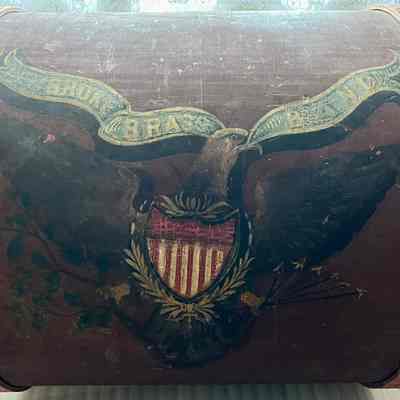
Bass Drum
A bentwood bass drum. The drum is a painted a dark red and features a large eagle carrying a banner in its beak that says "Pembroke Brass Band". There is a shield or coat of arms on its chest with red and white stripes surrounded by a gold floral design. In one talon it carries a branch and in the other arrows. Inside the drum it says "Made and Sold by Calvin Edwards, Gorham". The heads were once stretched animal hide but as these were cracked it was replaced by canvas. This drum was used in the Pembroke Brass Band in Pembroke, Maine.
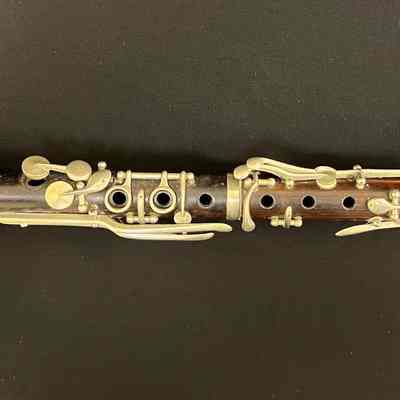
Clarinet
One hardwood 'piccolo clarinet' marked "M Martin France" on reed clamp with silver keys. This is an Eb Martin clarinet, dating from the 1870's. It can be taken apart in to four sections to be stored in a case.
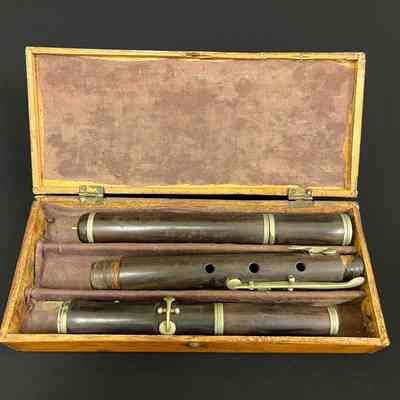
Flute
Hardwood flute with German silver keys in a wooden, cloth lined presentation box. Flute can be taken apart and stored in the box.
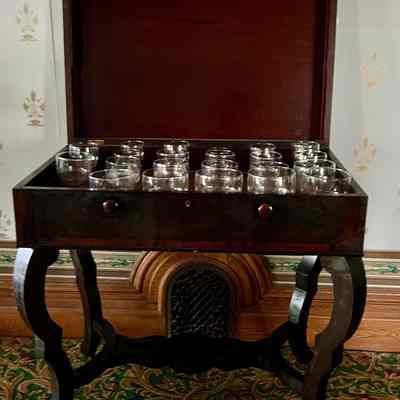
Grand Harmonicon
Mahogany case on stand with 22 toned glasses. Known as a Grand Harmonicon, this is attributed to Francis Hopkinson Smith, a nephew of Francis Hopkinson, a signer of the Declaration of Independence. Smith was based near to Baltimore, MD, building and selling these in the 1825-1835 period. According to Dennis James, a musical performer and curator, this a smaller one of the typical production, and housed in an unusual cabinet. Sometimes referred to as a "glass harmonica." Each glass is blown to a musical pitch. There appear to be parts of several sets of toned glasses. Some are engraved with the note on the stem. It is played by rubbing a wet finger around the rim of the glass.
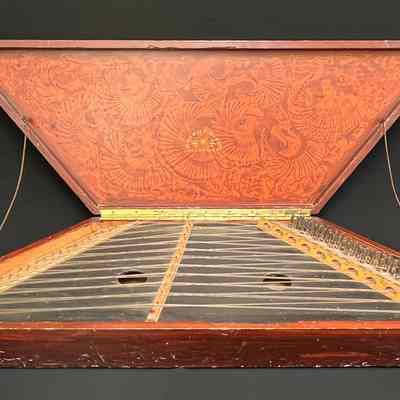
Hammered Dulcimer
One hammered dulcimer, sometimes called a hammer dulcimer, constructed from painted pine in a trapezoidal case. Painted and grained on inside cover in flowing shell designs. The case is hinged with two cords on each side to keep the propped open. On the left side there are 12 sets of 4 raised iron pegs alternating with 11 sets of 2 iron pegs. The side panels have a clear finish, as do the flank and the sounding board. An iron rod is inset on the edge of the left maple panel and protects the wood from the strings. There is a black painted sounding board with two circular resonator holes. One bridge, pierced with circular holes, is glued almost perpendicular to the front. Another is on the far right. The following words are stenciled in gold on the underside of lid: “P. Wight, Maker / Alabama, NY ". Includes 2 hammers and one tuner.
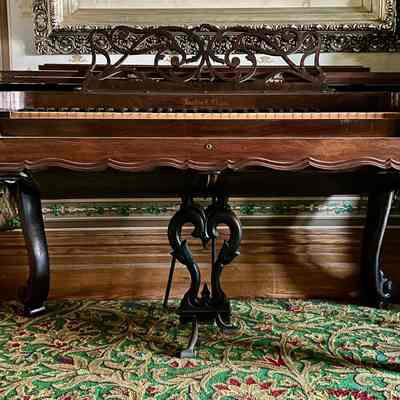
Melodeon
Rectangular reed melodeon with pierced music rack. Wavy molding around case. Cabriole legs with cast iron grape design. Marked "Austin C. Chase / Syracuse".
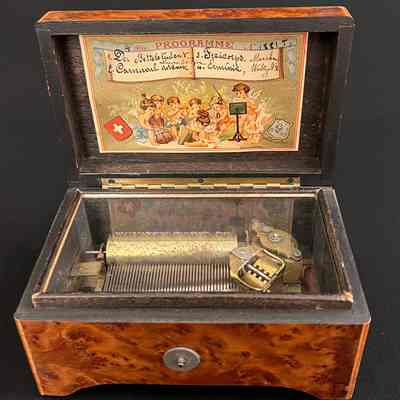
Music Box
Small Swiss music box, rectangular in shape, with burl-wood veneer and satinwood edging with a hinged lid. The lower half of each side has an arch to create "feet", each of which has a round metal stud underneath. The front and side have small pewter discs, one is most likely for winding and the other for starting and stopping the music. Glass encloses the inside top where the mechanics can be viewed. A label is affixed to the inner part of the lid. Label: "4 Airs Programme N 1881 T,". Four song titles are written in ink. 1. In German "Der Bettelstudent" (The Beggar Student), 2. In French "Carnaval de Venise" (Carnaval of Venice), 3. In German "Freicorps, March" and 4. In German, "Erminie", Waltz No 1. Gold label features cupids playing music, two shields, one red with white cross, one pale blue with gold cross and shield border.
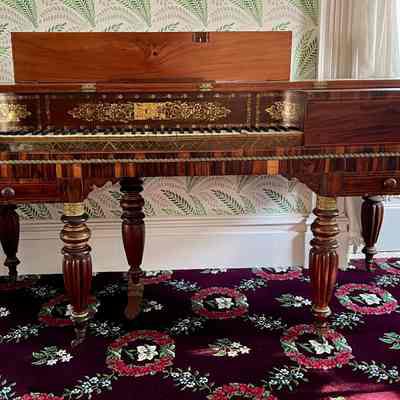
Pianoforte
One pianoforte in the Sheraton style with six reeded legs. The piano is surfaced with Rosewood veneer and decorated with inlays of brass beading and sleeves on the upper portions of the legs. It has two drawers with wooden pulls. A stenciled maker's name is located on the fall board and reads: "Made by Jason Herlson, Chamber Street, New York". This pianoforte has five octaves.
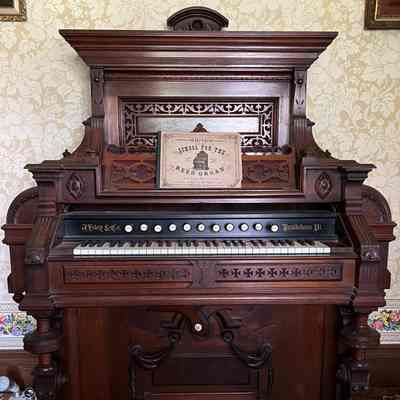
Reed Organ
A reed organ with 11 stops, 81 keys, and 5 octaves. Grooved line and gouged carving with an arched crest with foliate design and knee swells. There is an arched and drapery carving on base above pedals. Carpet covers the foot pedals. Marked "Estey & Co. Brattleboro, Vt."
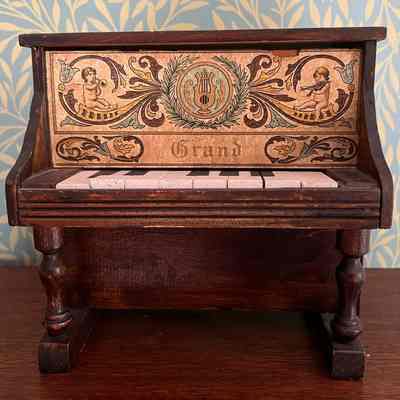
Toy Piano
Child's toy upright piano with eight painted playable keys. Paper plaque on face has two cherubs, one playing a trumpet, the other a violin. There is a lyre in the center surrounded by laurel leaves, a decorative floral pattern, and the word "Grand". Colors on the plaque are brown, gold and turquoise.
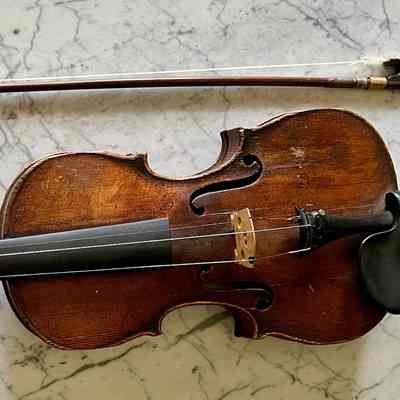
Violin
One violin originally owned by Erastus and Julia Hyde, first residents of the octagon house in the Village. The violin was made in Czechoslovakia c.1890 and bears an illegible repair label. It has a two piece maple back of narrow flame, horizontal with ribs of narrower flame. The top is of mostly narrow straight grain spruce and the varnish is an antiqued red brown. It has new parts such as a chin rest, bow, modern strings, etc.