

Dress
Clothing/Dress/Costume
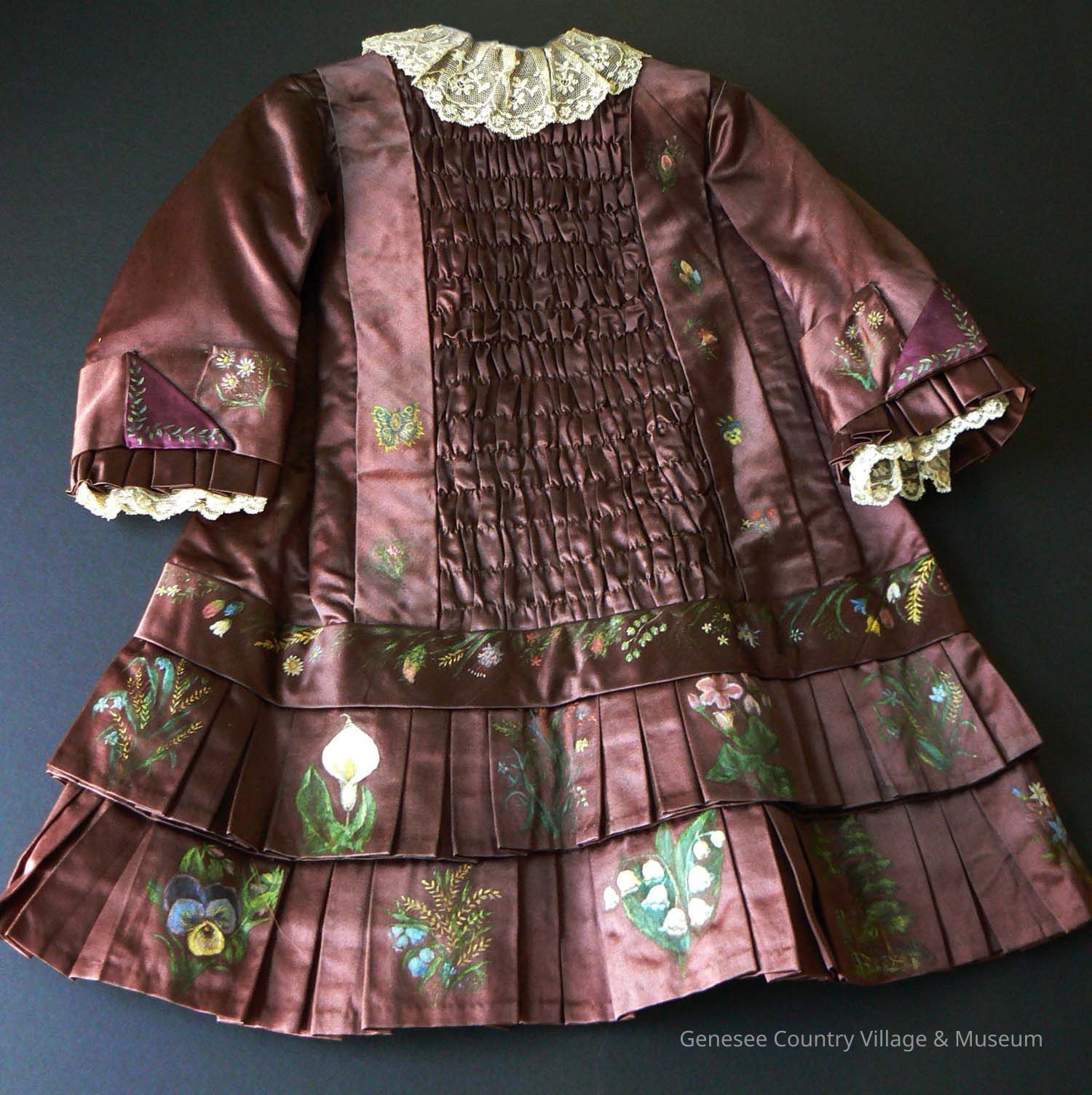
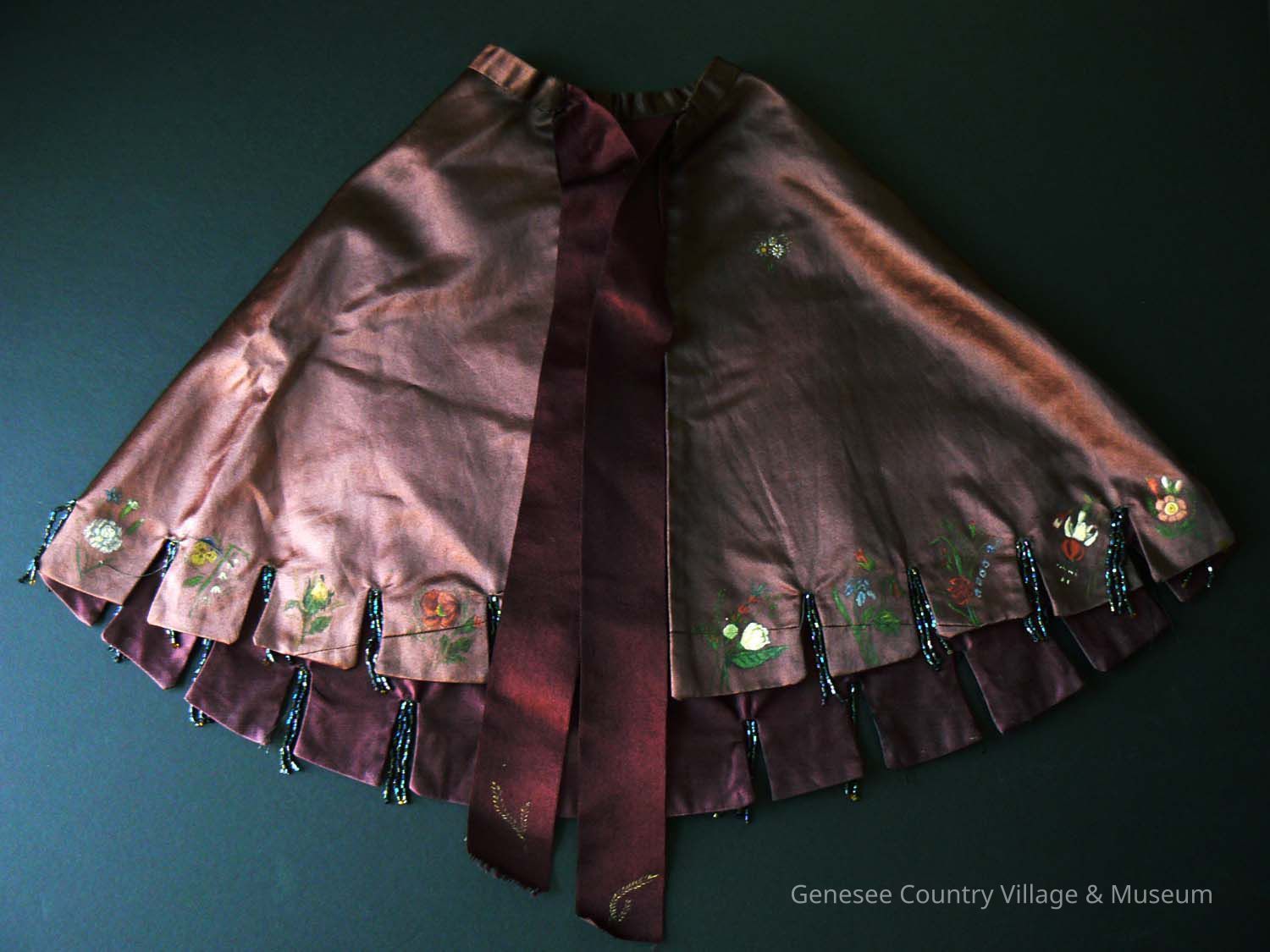
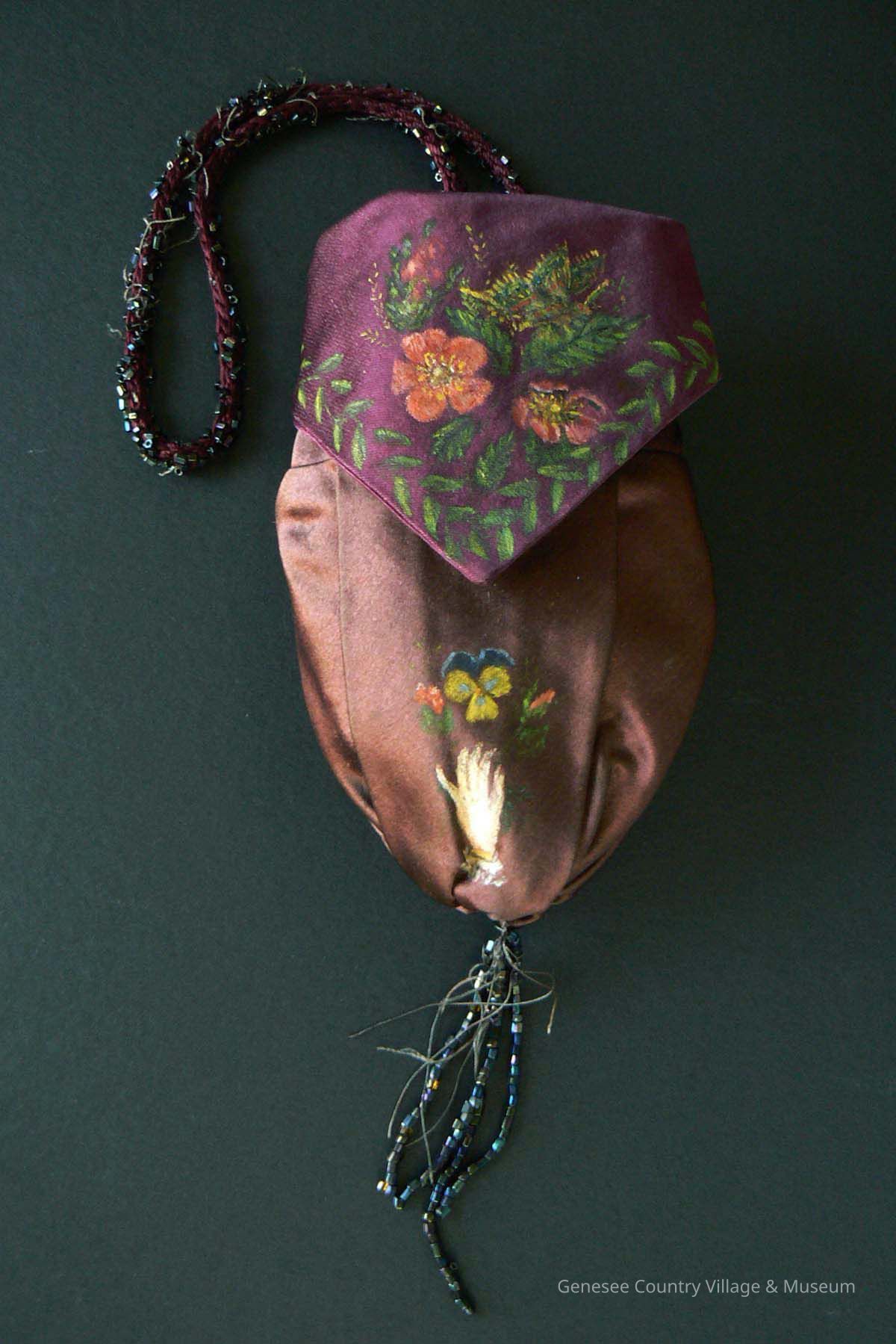
Girl's ensemble made of rich brown / eggplant purple silk satin. Embellished with beautifully painted flowers, birds, etc., and black iridescent beads, apparently original. Dress (a) - very low waist band above double row of medium width box pleats; center bodice panel between flat bands has horizontal shirred rows. Long straight sleeves with turnback cuffs above narrow box pleated frill. Lace edging (machine run) gathered around the neck for a simple collar, and lace frill inside cuffs. Back opening; full length; has 14 iridescent black glass buttons with a bird design. Cape (b) - with attached wide ribbon ties with little floral sprays painted at the bottom. Bottom finished with crenelated effect achieved with spaced slits. Lined with maroon silk. Between each flap is a double or triple strand of black bead fringe. Purse (c) - with rounded bottom and pointed flap made of the cape lining. Black bead tassel at the bottom, and knit strap with beads forms the handle.
G2012.054.a-c
Bruce and Susan Greene Costume Collection
Child, Female
Dress
Historic Costume
Dress
Female
Silk
Satin
Lace
Purple
1880
American
3
Dress - G2012.054.a Cape - G2012.054.b Purse - G2012.054.c
This charming three-piece ensemble consists of a dress, a cape, and matching purse all of a deep plum satin silk. Each piece of this ensemble is delicately hand-painted with small sprigs of flowers, groupings of pines, birds, trees, butterflies, and even a small lady's hand. Lily of the valley, pansies, white lily, violets, blue columbines, irises, and calla lilies absolutely cover the dress, the cape, and small purse. Floriography, or "the language of flowers" so popular in England the United States in the late 19th century, suggests that the child in question may have been Catholic, as many of these flowers are associated with the Madonna. The extent of fine quality and hand-crafted delicacy of these three pieces indicate that whatever their religious affiliation, the child for whom this ensemble was made was most beloved. The dress itself mimics the fashion taste of upper-middle class adult women in the 1880s, albeit in diminutive scale. A panel of ruching extends from the neckline to the dropped waistline, underpinned by a skirt of two layers of deep graduated box pleats. Each box pleat features a hand-painted floral sprig, while the waistband itself is lush with smaller scale flowers and ears of wheat. These box pleats are repeated at the cuffs of the tight sleeves, cut with a slight coat sleeve curve. The turn-up cuffs are also painted, with facings of maroon silk fabric, also painted with small laurel swags. The dress closes in the center back with 17 iridescent glass buttons, all intact, cast featuring sparrows and songbirds. The neckline and cuffs are filled with embroidered machined-netting. The rounded cape of deep plum silk is lined completed with the same maroon silk of the cuffs and dress. Crenellated edging of the cape echoes the box pleats of the skirt and cuffs, with each crenel featuring a hand-painted flower, sylvan leaves, or small grouping of pines and shade trees. Tassels of small iridescent glass beads, the same glass as the buttons of the dress, dangle in between each crenel of the cape, adding an element of sparkling movement to this cape. Lastly the purse, also made of deep plum silk, features a draw-string cord of braided silk, and is lined with maroon silk fabric. A small lady's hand, holding a sprig of flowers, features prominently on the front of this purse - a symbol of fidelity and a gift of affection.