

Dress
Clothing/Dress/Costume
2-piece dress with petticoat. Bodice (a) - made of silk satin with gathered mono-bosom pigeon breast front. Puffed short sleeves trimmed in small gathers of cream silk voile. Silk voile trimming across wide scoop neckline. Waist has a horizontal bands of satin silk, slightly gathered. Center back closes with hook and eye. Some eyes are fabric, some are metal. Tension-closure hooks labelled "Cholls". Velvet magenta rosettes (three) close back waist band. Lined completely in silk ivory taffeta. Seven vertical bones across waistband, which is lined with a thick cotton twill in light brown. Taffeta ties at center back and center front neckline. Skirt (b) - ombre silk satin; made of 8 panels. Center front has two darts and lies flat while 7 back panels gathered in three rows of gathers. Unlined. Deep purple velvet flounce at hem, faced with shot twill matching ombre colors. Center back snap closure with hooks and eyes to attach to bodice; seams left unfinished. Petticoat (c) - made of silk taffeta in ivory. Four gored panels with two gusset inserts at hem. Knife pleats 9" deep hem, which are very dense. Darted around waist - no pleats or gathers. Machine-stitched. Hook and eye closure at the center back; unfinished interior seams. Petticoat is stored in a different location. Boxed, on Shelf 1 [Bay 217: Storage Room 2: John L. Wehle Gallery].
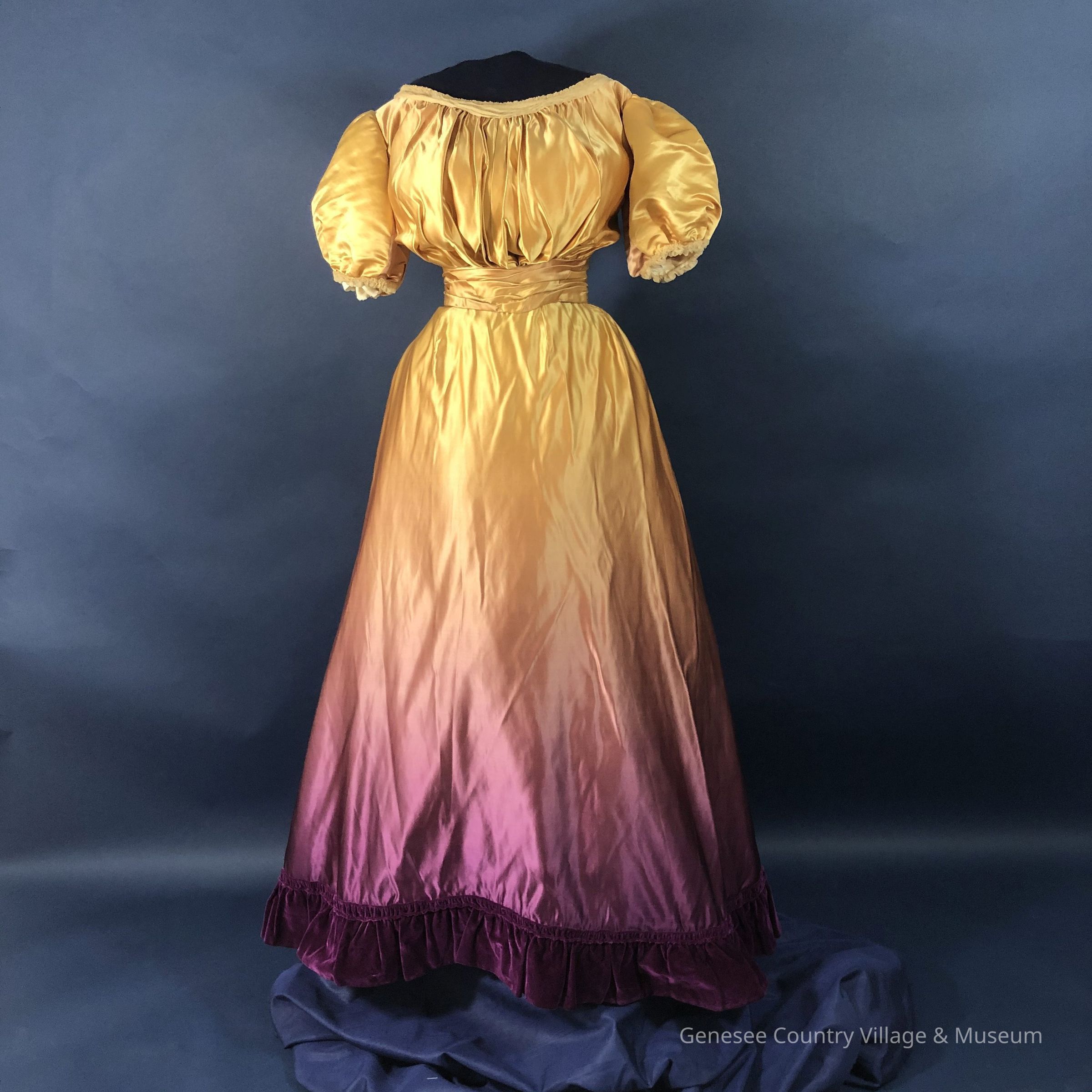
2019.10.1a-c
Genesee Country Village and Museum
Adult, Female
Historic Costume
Dress
Female
Satin
Taffeta
Velvet
Cotton
1906 - 1908
Bodice
13-1/2 in
29 in
W - 22 1/2" - Waist
Skirt
48 in
25 in
129 in
3
Bodice - 2019.10.1a Skirt - 2019.10.1b Petticoat - 2019.10.1c
Strong, Alice Woodbury
Rochester
New York
United States of America
North America
Alice Woodbury, nee Motley in 1859, was the mother of local collector and philanthropist Margaret Woodbury Strong, the incredibly large collection of whom would eventually form the basis of collections at Strong National Museum of Play. Alice, along with her husband John Charles Woodbury, was born into privileged circumstances. Her father was the owner of a local and highly successful flour-milling business. This upbringing and later marriage to John Charles established the Woodbury family as a staple of late 19th and early 20th century Rochester society. The Woodburies, including Margaret, travelled extensively in the 1890s, moving across the globe, accumulating objects d'art as they went along. This passion for collecting would of course be passed down to their daughter. Alice Motley Woodbury, with her many advantages and highly rarified sense of taste, cultivated a distinct fashion palette. This evening gown of brilliant ombre silk satin once belonged to Alice, dating from the first decade of the 20th century. The gown features an incredibly bright golden yellow hue on the bodice and waist, transitioning at the hem to its complement color of a deep purple. The brilliance of these colors is due in part to the advancements of fabric dying techniques developed in the second half of the 19th century. The silhouette of the gown recalls the "pigeon-breast" or "mono-bosom" so ideal in a lady's figure in the early 20th century. This silhouette was achieved, not with the natural line of the body, but instead with the new S-bend corset, along with deliberate and decisive padding to the hips and bust. These hip pads and "bust-improvers" manipulated proportions of the body in a way that created the illusion of an even smaller waist. This evening gown required the wearer to don these supportive structures to attain this sartorial ideal. The ensemble itself is three pieces; an evening bodice of short sleeves, a long tulip-like skirt with a slight train, and a silk taffeta petticoat. Golden yellow silk satin covers the bodice, made with short puffed sleeves, and is lined with pale cream silk taffeta. The exterior waist of the bodice is made from loosely pleat-gathered silk satin, while the interior waist is lined with brown cotton broadcloth and stiffened with several small stays across its entirety. The deep neckline of the bodice has a silk drawstring closure at the enter back, where the bodice itself also closes with the use of alternating tensioned hooks and eyes. The posterior waist closes with three deep purple velvet rosettes, each with a golden silk satin center. The neckline and the sleeves are finished with gently ruffled bands of silk gauze. The under-petticoat of pale champagne silk taffeta, the same as the lining of the bodice, consists of four panels, is gathered with simple ruffles at the center back waist, and hemmed with a panel of deep knife pleats. This petticoat is unlined and closes at the center back with several hooks and eyes. Pairing complementary colors together has the effect of intensifying both. This technique is employed in the outer skirt of this evening gown, where golden yellow and deep purple meet in brilliant opposition. The skirt of this evening ensemble closes at the center back with snaps, and is gathered to the waist with three rows of deep drawn ruffles. It is flat in the front and shaped smoothly over the hips by two darts on either side of the center front. The panels of the skirt have a flair moving toward the hem, creating a tulip shape. There is also a slight train to the back of the skirt. At the hem is sewn a deep purple velvet ruffle, the same velvet as the rosettes of the bodice, and is faced on the interior with shot yellow and purple twill fabric. The skirt is unlined with finished interior seams. Alice Motley Woodbury's dress encompasses both the feminine ideal of early 20th century America, as well as the delicacy that wealth could buy at this time. The daring use of color and refinement of materials employed by Alice in this evening gown are indicators of her wealth and status. No images of Alice wearing this gown exist, however the shear elegance of this gown, the extraordinary colors, and the quality of fabric suggest strongly this gown would have been worn for a society affair rather than an evening en famille. These qualities certainly helped to ensure its survival across the previous century. This evening ensemble highlights the transition from homespun handmade garments, to those made and sewn by machine. The fabric itself has been dyed an ombre. The ombre dyeing technique first came in vogue in the 1840s, however by the time this gown was made, had advanced considerably. Artificial dyeing techniques of the 1850s onward changed what colors and color variants were possible in clothing and decorative arts - the technology of which was certainly applied in dying the fabric of this gown. The interior seams are largely machined and finished, while the deep velvet hem, the silk gauze at the neckline and arm opening, and the hooks and eyes remain hand-sewn to the dress. Although made specifically for Alice Motley Woodbury nearly 120 years ago, the intense color and majesty of this gown remains awe-inspiring to modern audiences.