

Husking Peg
Object/Artifact
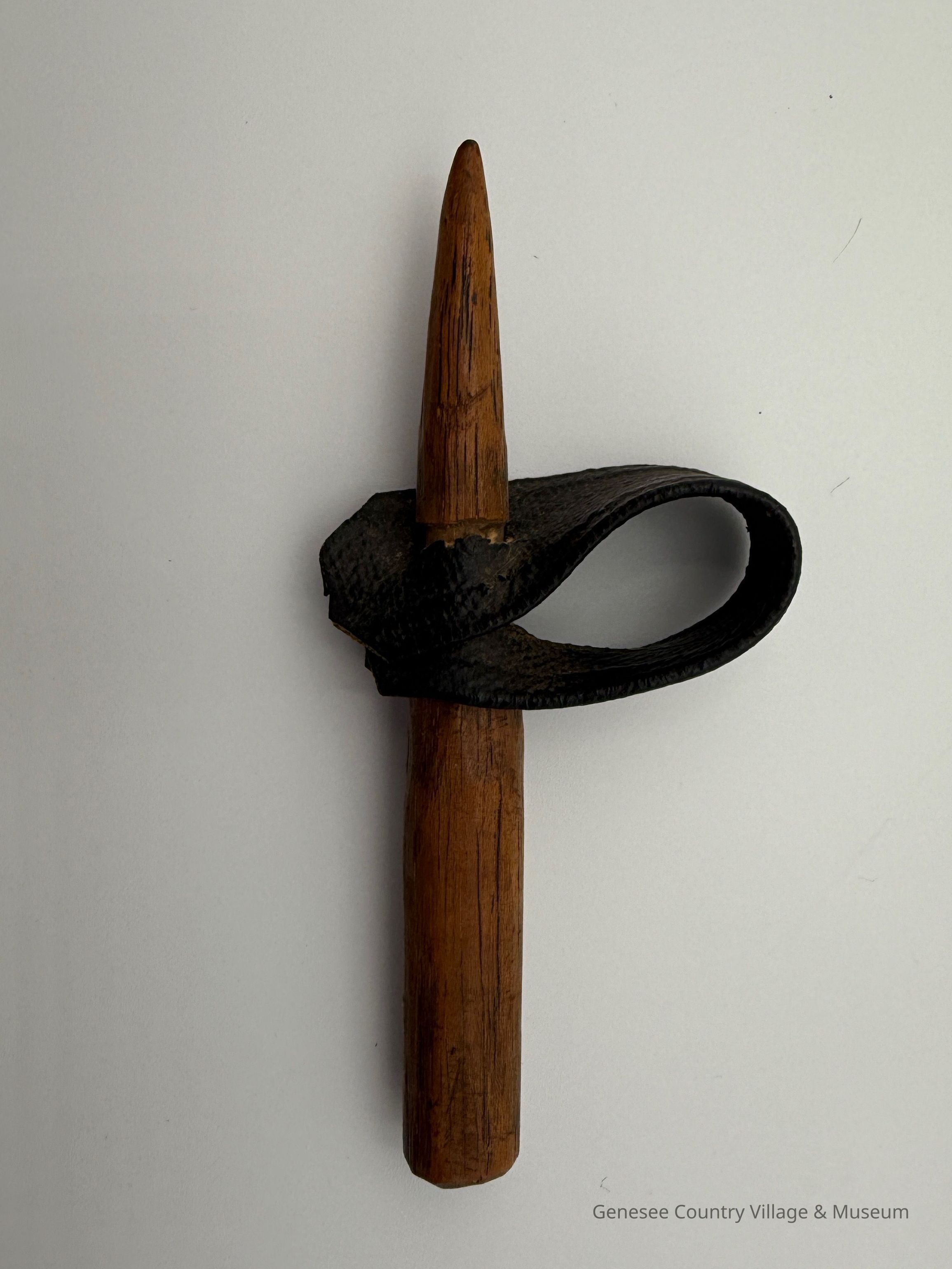
Wooden husking peg with attached leather loop. Sharpened point at one end.
2020.03.19
Before the invention of the mechanical corn husker in the early 1890s, husking had to be done by hand. Farmers came up with many implements to help them succeed in this task. Starting in the mid 1850’s hundreds of patents were issued for different styles of hand huskers from simple metal hooks placed around the thumb to more complicated hooks or pegs attached to the wrist with leather straps. Many husking pegs, such as the ones shown here, were hand made. Carved wooden pegs with a leather loop were the easiest to make but wrought-iron pegs could be wrapped in leather and used in the same way. It is thought that the middle finger slipped through the leather loop with the spike pointing downwards. The ear of corn was grasped in the left hand, with the top facing upwards, and the peg would be driven downward between the dried husk and ear. The thumb would be used to help grasp the husk and pull it off the ear. Some simple husking pegs have larger loops that all the middle fingers were placed through. An ear of corn could be husked in a matter of seconds.
Genesee Country Village and Museum
4-3/4 in
Wood
Leather