

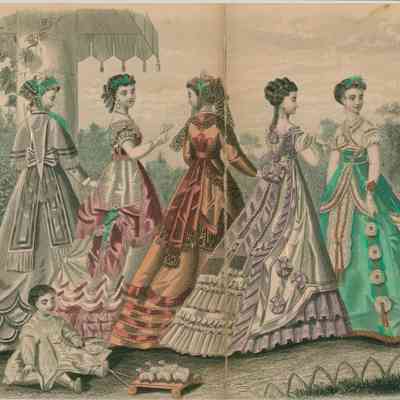
5 Ladies & Child in Garden
Fashion plate depicting five women and one child. The first woman, viewed from the back, is wearing a grey dress with scalloped layers at the hem and a large bow at the center back with long, flat streamers. It is trimmed in black bands and fringe. On her head, a green cap with black lace trim. The second woman, viewed from the back, is wearing a white dress with fringed, pink drapery and rows of pink, scalloped bands at ruffles at the hem. Small floral ornaments pin the drapery to her skirt and crown her head. The child is wearing a short, white dress with a matching coat. The third woman, viewed from the back, is wearing an orange dress with rust-colored bands at the hem of her skirt and in stylized panels at the center back, trimmed with black lace. On her head, an orange cap trimmed with black lace. The fourth woman, viewed from the back, is wearing a white dress with lavender trim. It is elaborately ornamented with frills, rosettes, and fringed ribbon. The fifth woman is wearing a green dress with white lace trim and orange cording details that continue from the blouse down to the hem of the skirt.

Apothecary Shelf
Tin apothecary hanging shelf with space for 10 vials. 9 vials are associated with this object. Two punched holes are at the top of the shelf with a piece of twine is tied to create a hanger. A mixture of curved lines following the curve of the shelf are decorative with vertical line pattern on the left and right.
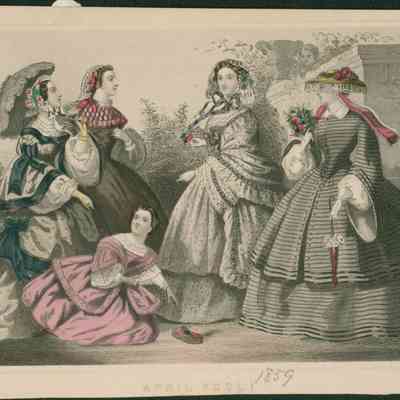
April Fool 1859
Fashion plate depicting four women and a girl. The first woman is wearing a grey dress with a wide, square neckline and pagoda sleeves that open to reveal globular undersleeves. The overskirt, cuffs, and neckline are trimmed in thick black border and matching ribbon bows. In her hand, a grey, fringed parasol. On her head, a cap with a green band at the crown. The second woman is wearing a simple brown dress with a red and white plaid shawl around the neck. On her head, a day cap with red ribbon. The girl is wearing a pink dress with a border of frills along the edge of the overskirt, the sleeves, and the deep collar.The third woman is wearing a spotted white dress with a double-tiered skirt and bell sleeves. The dress and the matching shawl are trimmed in grey ribbon and lace frills. On her head, a lingerie cap with a matching ribbon bow. The woman on the right is wearing a grey dress with horizontal stripes and a double-tiered skirt with black bands along both hems. On her head, a straw hat with pink ribbon and lace along the brim. In her hand, a pink parasol. The date is written in pencil at the bottom of the page.
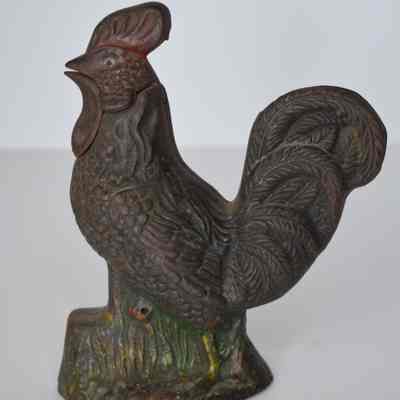
Bank
Molded cast iron rooster toy bank with brown body and red head and cockscomb. Base decorated in red, green, yellow, and orange paint.
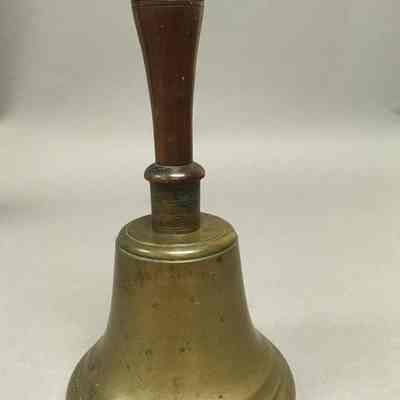
Bell, School
Large brass handbell with a wooden handle for calling together school children; bell handle has a nut and bolt at top, then a baluster shaped handle of wood with two incised lines at the shoulder; neck then descends to an attachment to a brass cylindrical collar with a turned lip and stem with annular rings; handle and collar are then attached with the bolt to a bell shaped spun brass bell with a flat top; top is chamfered with an ogee molding, thence to a flared bell and base with a concave ring, then a stepped ring, then a bulbous base; interior of the bell has an iron chain secured to the handle bolt with an eye bolt, then to an iron ball as a clapper.
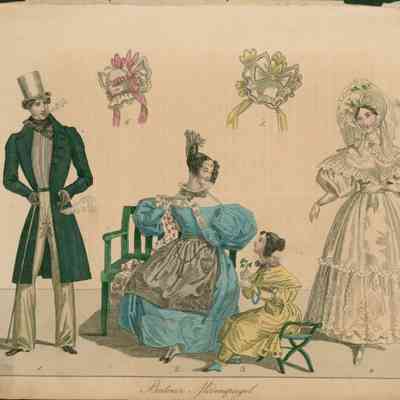
Berliner Modenspiegel No. 39
Fashion plate depicting a man, two women, and a girl. The man is wearing a green frock coat over a red and blue striped vest, a black cravat, and tan trousers. On his head, a grey top hat. The first woman is wearing a blue dress with gigot sleeves, a white floral shawl and a grey apron. The girl is wearing a yellow dress with matching pantalettes. The second woman is wearing a white, elaborately decorated gown with a lace-trimmed pelerine. On her head, a white bonnet with a veil draped over it. Above them, a day cap with pink ribbon and a day cap with yellow ribbon.

Blacksmith Box
Blacksmith box owned by John Thomas (JT) Caley. Box is made of wood with a cast iron handle that curves over the box. Cast iron strips are screwed onto the edges for stability. There is a larger compartment at the bottom and a small compartment divided into four areas at the top.
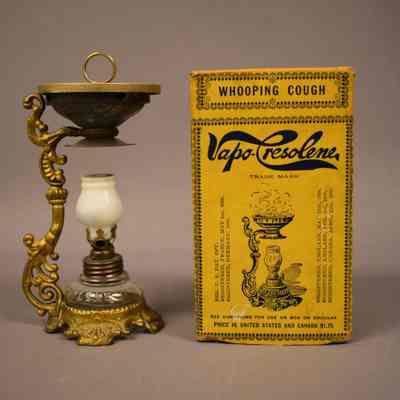
Box, Packing
Rectangular yellow box with black writing; all four sides of the box have inscriptions; box has no top; froint side of box has an image of a Vapo-Cresolene Lamp; box is worn around edges and browning. Front of box with image of vapo-cresolene lamp: "Vapo-Cresolene Trade Mark REG. U. S. PAT. OFF. REGISTERED, FRANCE, MAY 1ST, 1884. REGISTERED, GERMANY, 1889. REGISTERED, ENGLAND, MAY 15TH 1888. REGISTERED, ENGLAND, FEB 3RD. 1897. REGISTERED, CANADA, APRIL 12TH, 1893. SEE DIRECTIONS FOR USE ON BOX OR CIRCULAR Price in United States and Canada $1.50; Great Britain, 6s." Wall of box to the right of the front: "Vapo-Cresolene VAPORIZER. The medical profession and the public have required a medium for impregnating the atmosphere with remedial agents. Numerous atomizers have been invented, and extensively sold; these have been only partially effective as the particles of liquid sink to the floor and the treatment is only applicable for short intervals and while the patient is awake. The use of vaporized antiseptics for certain inflammatory diseases of the air passages is well recognized and valuable method of treatment. The patient is enabled to breathe an atmosphere permeated with the desired medicament for a more or less prolonged interval, preferably at night; and may undergo the treatment undisturbed and at a time when rest is most desired. The air-passages and lungs are then penetrated by the restorative vapor with every breath. Cresolene has been used for many years with success as a vaoprized remedy in the treatment of the diseases for which it is recommended." Wall of the box to the left of the front: "DIRECTIONS FOR USE Fill the lamp with the best Kerosene (Petroleum) Oil obtainable. Alcohol will explode the lamp if used in it. Light the lamp allowing as large a flame as possible; but care must be taken for the first fifteen minutes to see that it does not smoke. Place the lamp under the Vaporizer. Place the Vaporizer in a tin or crockery dish to guard against overturning, and set the same on a table near the bed. Lastly fill the moveable cup with CRESTOLENE. Tarry sediment remaining in the cup may be removed with alcohol. CRESTOLENE should be vaporized in a bedroom of ordinary size and the doors and windows should be kept closed while the Vaporizer is in use. In oppressive weather a window may be opened for ventalation. The most convenient time to use the Vaporizer is at night. The cup full of CRESOLENE is generally sufficient for a night's treatment. No injury is experienced by the most delicate child or person in health, from inhilation of CRESOLENE. The odor of CRESOLENE will soon pass away if the room is thoroghly aired during the day, CRESOLENE imparts a burning sensation to the skin and is poisonous if taken internally, it should, therefore, be kept out of reach of children. Alcohol, brandy or whiskey should be given at once if CRESOLENE is swallowed; or applied externally if it falls on the skin. CRESTOLENE grows darker with age but does not lose its virtue. Extras; Globes, 10 cents; Burners, 15 cents; Cups, 5 cents; Lamps Complete, 35 cents; Wicks, 10 cents per dozen. Cresolene Antiseptic Throat Tablets, 10 cents." Wall of box opposite the front: "Vpor-Cresolene A Germ Destroying Liquid to be vaporized. FOR Whooping Cough. Spasmodic Croup. Asthma. Catarrh, Colds, Bronchitis, Coughs, Hay Fever, Sore Throat, Broncho Pneumonia, The bronchial Complications of Scarlet Fever and Measles and as an aid in the Treatment of Diphtheria. For the Respiratory Diseases of Animals, as Distemper and Pneumonia in Horses and Dogs; Gapes and Roup in Fowls. Vapo-Cresolene CO. 62 Courtlandt St., New York, N.Y., U.S.A. ALLEN & HANBURYS, LTD., Sole Agents for Great Britain 37 LOMBARD ST., LONDON LEEMING MILES CO., LTD., LEEMING MILES BUILDING, SOLE AGENTS FOR CANADA MONTREAL."
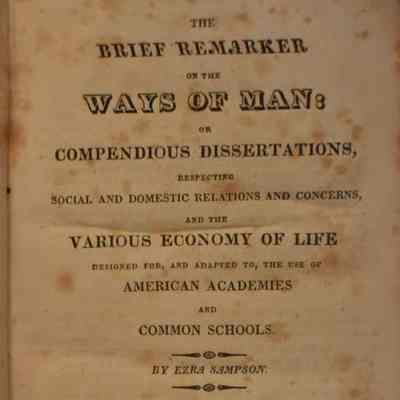
Brief Remarker on the Ways of Man, The:
Respecting social and domestic relations and concerns, and the various economy of life designed for, and adapted to, the use of American Academies and common schools.

Cabinet Card
A photograph of a young boy and girl beside each other with their arms interlocked. Subjects are Herbert and Beth Fulton. This photograph was taken just before their deaths. Herbert on August 12, 1889 and Beth on August 14, 1889. Their father John passed away just a few weeks later.

Candle Lantern
Half-round candle lantern. Flat front accommodates a pane of glass and the rounded back has a hinged door with pierced design.
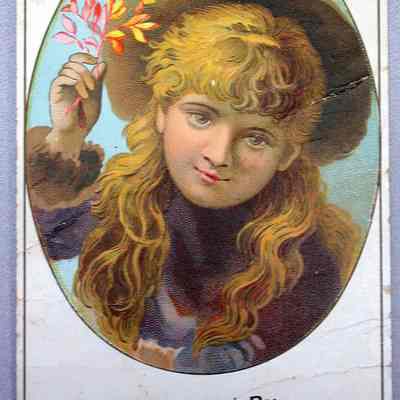
Card, Trade
One rectangular lithographed paper trade card for Burdock Blood Bitters. The front image is a little girl, wearing a hat and a small cluster of pink and yellow leaves. The front also has a stamp: "Presented By / A. D. CHAPMAN / WEST RUSH, N.Y." The back has promotional text.
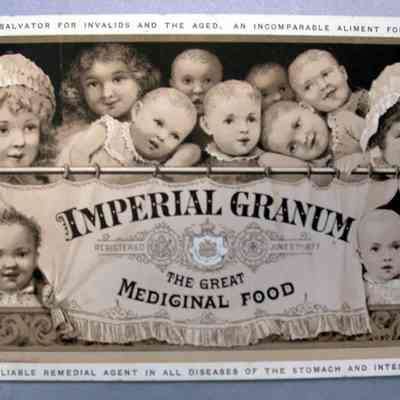
Card, Trade
One rectangular lithographed paper trade card for Imperial Granum, the great medicinal food. The brown and white front illustration shows a bunch of babies and small children peering out a storefront window over and around a curtain with promotional text. There is promotional text on the back.

Carte-de-Visite, Drew King Robinson & Lillian Edith Robinson
Little boy and girl image. The boy wears a black velvet suit of three pieces - buttons knickers, jacket and waistcoat. Large white "Eton" collar with white oversized tie. Tall leather boots. The girl wears a white infant frock, with scalloped hem edges. She holds a doll, and wears leather baby boots. Subject is Drew King Robinson & Lillian Edith Robinson.

Carte-de-visite
seated little girl wears dress with pin tuck bodice and a silk pinafore. she holds a doll
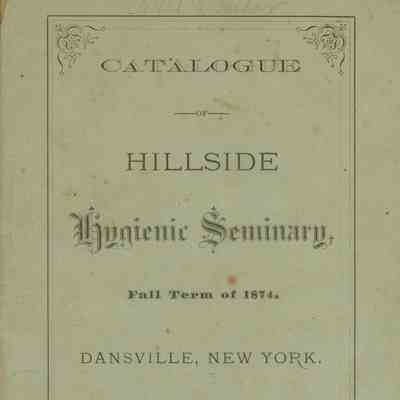
Catalogue of Hillside Hygienic Seminary
A catalogue for the Hillside Hygienic Seminary Fall Term of 1874.

Chair
Chair painted black with yellow striping. Stenciling on back slats and double rose stencil on crest slat. Double stretchers on front and sides.
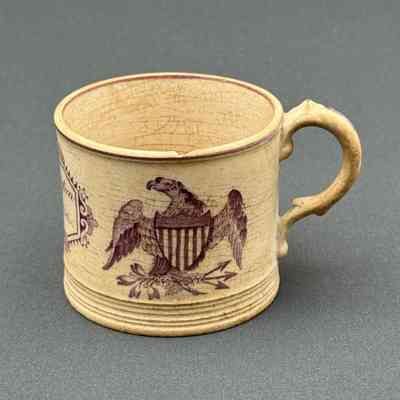
Child's Cup
A child’s ceramic mug decorated with a purple transfer design featuring eagles and a commemoration of George Washington, with the inscription “To Washington the Deliverer” and purple stripes accenting the rim and scrolled handle.
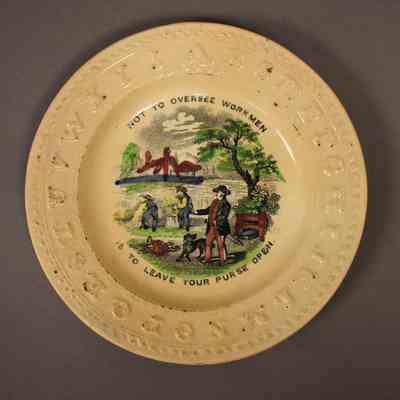
Child's Plate
The child's plate features a raised alphabet around the outer edge with a wave-like design around the very outer edge; in the center is a transferware, polychrome painted scene of a farmer with his dog; the farmer is directing two men gathering wheat in the field;trees, fencing and a house can also be seen in the scene; around the scene is a saying (or proverb) by Benjamin Franklin that reads "Not to Oversee Workmen is to Leave Your Purse Open."; the plate is finished with a smooth glaze; no markings to indicate a manufacturer.
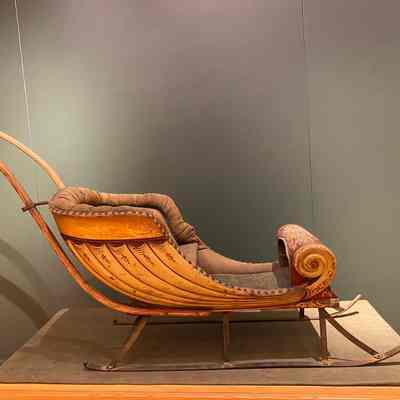
Child's Sled
Child's Sled made in the model shop of the Cunningham Car Co. of Rochester NY. In a cornucopia design with its original decoration - red with gilt decoration and gold with red decoration. Green upholstery with gimp and brass studs. Long wooden handle and metal runners.

Children's Sled
19th century children's sled made of a plank seat with a scalloped front and curved back. The seat has a hand painted design of yellow roses and daisies with a black border of geometric and vine designs. Three arched wooden supports with brass brackets attach the runners to the seat.
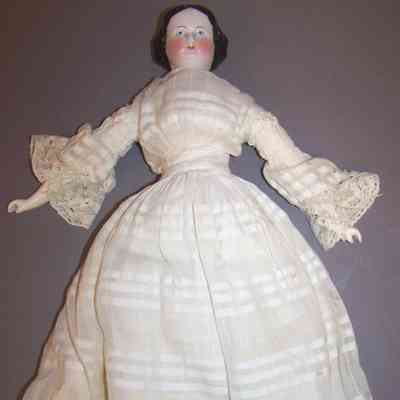
China Doll
China doll with original clothing. China head, arms and legs. White cotton lace trimmed dress.

Chinese Puzzle Game
Small Chinese puzzle game. Box is highly carved with people, trees, flowers, and buildings. Puzzle pieces form two rectangles.
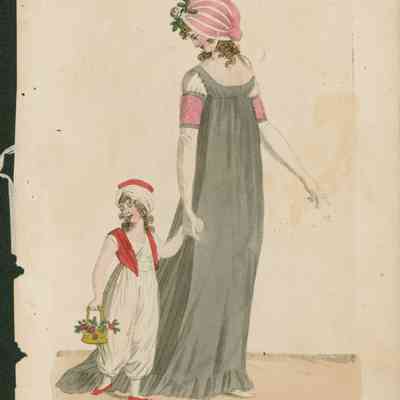
Costume Parisien, No. 33.3
Fashion plate depicting a mother and child. The woman is wearing a grey dress with white cap sleeves and pink bands at the cuffs. On her head, a pink and white striped turban with flowers at the front. The child is wearing a distinctly oriental-inspired outfit consisting of baggy white trousers, a red vest, and a white turban.
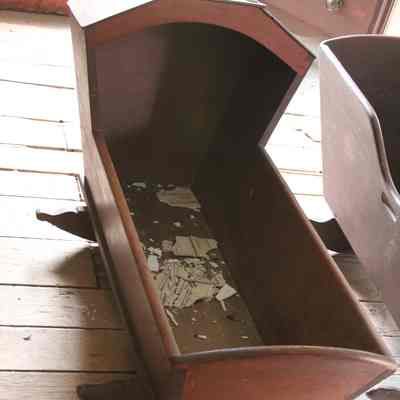
Cradle
Hooded cradle. Made for Katherine MacKay, daughter of Mordecai MacKay.

Cup
Cup with a black transfer of two young boys trying to reach a parrot in a cage that is hanging from the ceiling. Reads "TRYING TO REACH THE PARROT". Reproduction.

Dark Day, The
Small 16-page Sunday School tract.
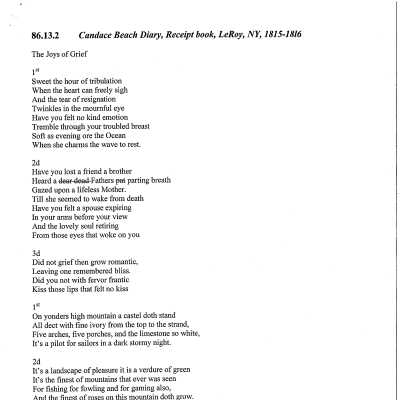
Diary of Candace Beach
One diary of Candace Beach (born 1790) who came from Hartland, Connecticut, in 1815 to LeRoy, New York. The diary tells of her slow trip west and teaching school after she arrived in LeRoy. There are also several poems in the diary at the beginning (The Joys of Grief, Untitled, Hard Times, The Banks of Champlain). Recipes for Loaf Cake, Hard Biscuit, and Puce Pies. There are three sections of accounts for Mrs. Nancy Wright, Mrs. Ford, and Mrs. Wright again. Then the diary notations begin on August 14, 1815, and continue to September 19, 1816.

Diary of Dr. John Sterricker Jr.
Diary of Dr. John Sterricker Jr., written when he was 15-16 years old. Writes about going away to school, activities, and friends and family. The office of John and his father, Dr. John Sterricker Sr., was moved from Roseboom, New York to the GCV&M.
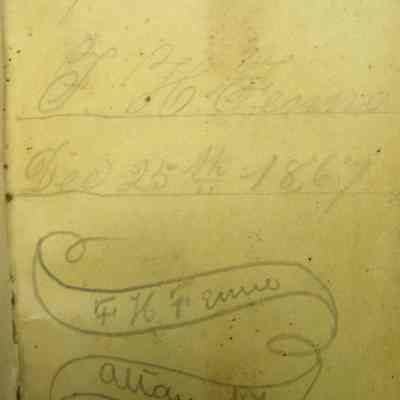
Diary of Frank Honeywell Fenno, 1867-1871
This small black journal of Frank Honeywell Fenno includes entries from 1868-1871. It is noted inside the front cover that this was "a present from W. J. Fenno the 25th day of Dec. 1867." The entries are sporadic and he uses the one diary for multiple years. He notes birthdays, deaths, celebration of Christmas, Fourth of July, and birthdays, base ball scores, playing croquet, comets and astronomical events, school, Sunday school, temperance speeches he gave, and daily life experiences. There is a separate printed square of paper, dated Feb. 16, 1869, listing Home Guards, of which Frank Fenno is a Lieutenant.
Diary of Frederick S. Gray, 1859-1860
One hardcover diary or journal kept by Frederick S. Gray of Geneseo, NY. The entries begin in September of 1859 as a continuation of the diary 2006.025.2. Entries conclude in July of 1860, and the remainder of the lined pages are unused. Although not yet transcribed, a skim through the pages references his classes at the Geneseo Academy.
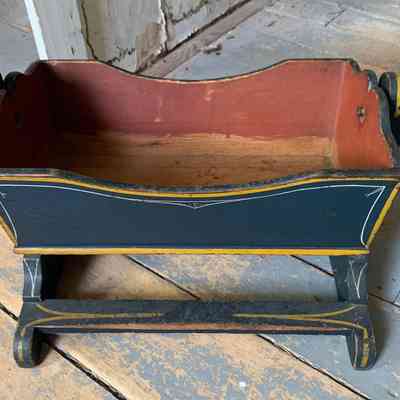
Doll Cradle
Cradle, doll Swinging cradle on frame. Interior in original red paint. Exterior in original dark blue-green paint. Banding and striping in ochre and white.

Domino Set
One set of 28 dominos with a tin box. The dominos are made of bone and ebonized wood held together with a brass tack.

Dr. Hand's Colic Cure
Small apothecary bottle with cork. Dr. Hand's Colic Cure contained about 12% alcohol and a hazardous ingredient called santonin which could cause convulsions, respiratory failure, or blindness in infants.

Drawers
Entirely hand-stitched girl's drawers made of plain white cotton. The bodice is a rectangle with self-straps. Closes in back with 2 buttons. Drawers open in the back and part way up the front; legs narrow at the bottom with a small hem.

Dress
2-piece machine-stitched girl's princess polonaise dress; made of brown silk taffeta with narrow stripes of space dyed yarn, (giving a ikat effect). Top (a) - high round neckline; long narrow sleeves set high on the shoulder, kilted frill at base of draped cuff and around the skirt hem. Skirt (b) - lined with glazed brown cotton, shaped at the bottom and pulled into puffs with blue and white striped cotton tapes. Polonaise has dropped waist with an asymmetrically draped apron front beneath a long V-shaped panel on the center front containing shirred fabric on the bias.

Dress
Entirely hand-stitched girl's dress made of gauzy India muslin and embroidered with white cotton in stem stitch. Tambour and very refined drawn thread work; in each corner of the hem is a large circle with elaborate drawn thread work surrounded by leaves and stems that border the piece; field has widely spaced springs with varied drawn thread work fillings; appears to originally have been an apron dating about 1760-1780; made of two whole 32.5" widths of cloth embroidered after joining; top is stitched into gathers under the arms where the top edge is just turned over to the inside to form the lower arc of the armscye; slightly scooped (apron waist) neckline with gathering tape; the back one goes over the sleeve tops as well; no waist; opens all the way down the back; short sleeves whose ends are worked in a bravura lace like drawn pattern with floral motifs; three casing with fine linen braided tapes draw the sleeve up in front, back and outside; no anchor point or buttons visible for free end of tape.

Dress
Entirely machine-stitched child’s dress made of white cotton. Square yoke front and back. Vertical strips of ruching with narrow insertion, surrounded by triangular tabs bordered and edged with lace. Very full long sleeves ending in insertion band and lace frills. Very full skirt set into yoke, with insertion above 4” hem. 3 small MOP buttons on yoke.

Dress
Entirely hand-stitched infant boy's dress made of fine white. High-waisted bodice gathered into the scooped neck with bound edge and drawstring. Inset waistband made of embroidered insertion (same as on 2004.131) forming casing for fine tape ties run along the top and bottom edge. Short double-puffed sleeves with cuff bands trimmed, like the neck, with Ayrshire edging. Long skirt gathered into waistband evenly all around. Unusually detailed embroidered insertion set with piping above the deep hem. The skirt front has vertical (not angled) robings on either side of a central embroidered strip with an eyelet center ‘vein’. The satin stitched designs are not Ayrshire, and look a lot like the work on the chemisette with the drawn thread sections, varied here, and the spiky flowers.

Dress
Entirely hand-stitched boy’s dress made of white cotton. white, insertion trim. High waisted with a slightly gathered bodice. Inset waistband with lace forming casing for a ribbon. Scoop neck with bound edge and drawstring. Short double-puffed sleeves. Skirt gathered into waistband evenly all around. Lace insertion above deep hem.

Dress
Girl’s dress made of pale celadon green Liberty silk, entirely hand stitched with silk thread. Smocked yoke and cuffs, embroidered pointed turned down collar and shoulder sections. Self covered buttons, 2 decorative ones in center front of collar. Pocket in right side. Lined completely with thin plain white cotton. Maybe it should have a matching sash like the gold Langdon dress; however the green one does not have one... This is important as an example of a wealthy child’s “greenery yallery” reform dress, the young Ida Langdon being a good example of such. She had more than one as evidenced in her portraits.

Dress
Little boy’s dress, entirely hand stitched. Made of brilliant printed with black and red spot pattern. Bodice gathered generously into shallow yoke with wide shallow neckline. Short, straight sleeves trimmed with 2 rows of Ayreshire edging. Short skirt gathered into piped self waistband. 2 pearl buttons on waistband in back, and 2 more on yoke. Skirt length and bodice side seam the same measurements as the other dress, but this one looks smaller!

Dress
Entirely hand-stitched girls dress made of Delaine fabric; orange ground with alternating round 'buds,' one lilac with white surround, the other red with dark teal surround, superimposed on bleached-out-looking yellow leaves and bars. Infant bodice gathered into yoke with shallow wide neckline; lined with white cotton; back opening closed with tiny incised 4-hole mother of pearl buttons. Full long sleeves gathered into narrow cuffs; jockeys curved up to armscye. Set-in waistband. Short skirt, tuck above hem which is faced with pinked white cotton. Skirt was gathered with a layer of printed cotton to give body to it. Top stitched with white silk thread. Neck and jockeys bound with 1 1/8" fancy ribbon, also used to form a bowknot at the top of the sleeve. The ribbon has yellow ribbed brocade stripes on the sides with a deliciated brocaded pink rosebud trail down the center. Very lovingly made.

Dress
3-piece girl's dress made of fine peach-colored 'cashmere' partly machine stitched. Trimmed with 3 rows of narrow cerulean blue velvet ribbon on all hems. Basque with princess seaming has longer pointed 'tails' in back; turquoise velvet colored dome buttons close the back. Long pagoda sleeves with machine lace edging tacked to the inside of the sleeve hem; a narrow lace frill at the high neck. Piped armscyes. 2-lobed apron overskirt (a) - high at the sides; plain cotton waistband is basted onto the similar skirt waistband. Shin-length skirt is full, more so in the back, closes with a large brass hook. Basque (b) - lined with plain white or cream cotton. Skirt (c) - lined with coarser, thin sized natural cotton lining. Bodice was made with fabric from slightly different dye lots.

Dress
Girl's ensemble made of rich brown / eggplant purple silk satin. Embellished with beautifully painted flowers, birds, etc., and black iridescent beads, apparently original. Dress (a) - very low waist band above double row of medium width box pleats; center bodice panel between flat bands has horizontal shirred rows. Long straight sleeves with turnback cuffs above narrow box pleated frill. Lace edging (machine run) gathered around the neck for a simple collar, and lace frill inside cuffs. Back opening; full length; has 14 iridescent black glass buttons with a bird design. Cape (b) - with attached wide ribbon ties with little floral sprays painted at the bottom. Bottom finished with crenelated effect achieved with spaced slits. Lined with maroon silk. Between each flap is a double or triple strand of black bead fringe. Purse (c) - with rounded bottom and pointed flap made of the cape lining. Black bead tassel at the bottom, and knit strap with beads forms the handle.

Dress, Christening
Infant’s Christening gown made of soft ivory silk satin, trimmed with ivory fly fringe. Entirely hand stitched with off white linen S singles thread. Bodice lined with ivory cotton jean (MID) that has pilled; skirt and sleeves lined with fine ivory Persian with light blue selvages showing through. Front neckline has a double-curved “sweetheart” neckline.Tubular sleeves with cuffs, finished before being tacked to lower armscye of finished bodice. Finished straps with curved ends are attached at back neck; appear to have been stitched to sleeve tops after the baby was inside it. Body and skirt cut in one and fitted to body with sets of released pleats — 3 on either side of front, 1 at each side, and 3 inverted pleats in back. Bottoms of front pleats stitched in place at hem. Elaborate ivory silk loop and fly fringe sewn straight along the edge of cuff and the front opening of skirt; it meanders slightly around the hem.
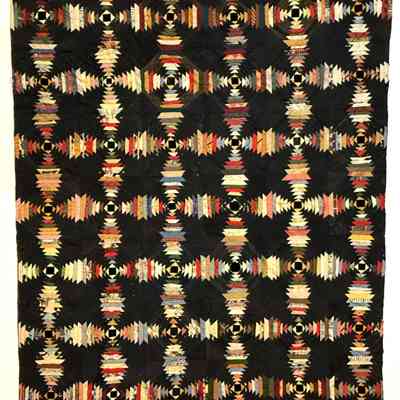
Dressmaker's Quilt
A silk and satin quilt made by Eliza Jane Eldridge of Angelica, New York. The quilt style is called "Pineapple Log Cabin" or "Windmill Blades". Eliza Jane was born on May 2, 1850, in Angelica, New York to Henry Wright Eldridge and Caroline Henrietta Scheank Eldridge. Eliza was a dressmaker and worked out of her home on Mechanic Street in Angelica. It is believed she used scraps of the clothes she made for this quilt. Eliza died on May 31, 1912 and is buried in Until the Dawn Cemetery in Angelica. This is a small, light weight quilt, perhaps used as a lap quilt or table covering.
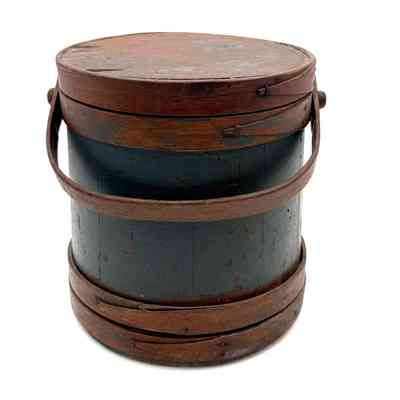
Firkin
One blue painted firkin with wooden cover and wooden bail handle.
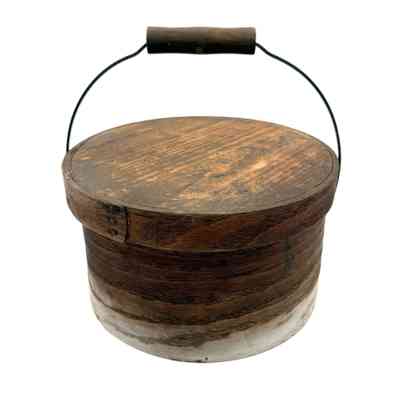
Firkin
Round covered firkin with bale handle.

Form Book from Eastman Business College
A form book belonging to John C. Miller Jr., student at Eastman Business College. Contents include notes on penmanship and journaling as well as autographs from classmates as part of their penmanship practice. 1863. A set of stencils, 2 loose drawings, and a loose poem were found in the book.

Frilly Ladies and Girl in Pink
One lady in pale green tiered dress and black mantle gesturing to another wearing blue and brown tiered dress, each with elbow length bell sleeves and very frilled undersleeves. Also a little girl dressed in a flaring pink tiered dress with bretelles and cross straps in front. Altogether very frillly. Marked: “Magasin des demoiselles....Bureaux du Journal 51 Rue Lafitte Paris.”
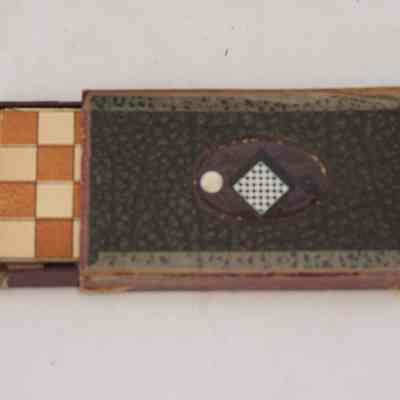
Game
One portable game set of the mid-19th century. Parts consist of a box which has a tray (2001.055.1.1) and a case (2001.055.1.2); a folded cardboard game board (2001.055.1.3) with a checkers game and a "nine-man Morris" printed on one side and a backgammon game printed on the other; 26 wooden checker pieces - 12 natural wood color and 14 stained black (2001.055.1.4) and two white colored ceramic die (2001.055.1.5)
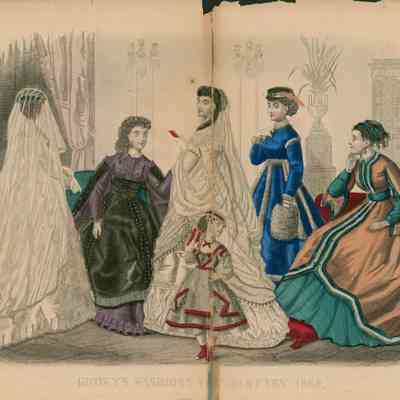
Godey's Fashions for January 1868
Fashion plate depicting five women and a child. The first woman, viewed from the back, is in all-white bridal attire with scalloped trim and a long veil on her head. The second woman is wearing a purple dress with a black overskirt and black hanging sleeves with purple lining. Along the shoulders, collar, and hem are purple ruffles. The overskirt is trimmed with black cord and a rosette sits just off-center on her waist. The third woman is wearing all-white bridal attire. the dress has short, cap sleeves and elaborate decoration including ruching, beading, ruffles, and lace. From her head, a long, sheer veil. The child is wearing a grey dress with red trim and a matching hat. The fourth woman is wearing a blue dress with white fur trim and a white fur muff. On her head, a short, black hat with an orange plume. The fifth woman is wearing a green dress with long, tight sleeves under an orange overdress with hanging sleeves and green and white trim.
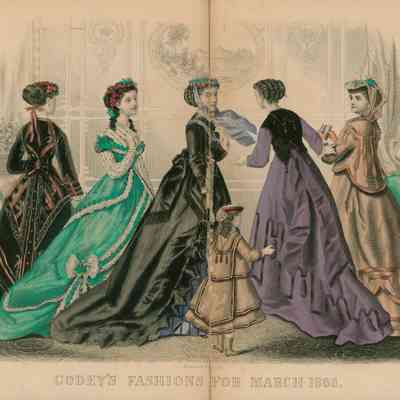
Godey's Fashions for March 1868
Fashion plate depicting five women and a child. The first woman, viewed from the back, is wearing a black dress with geometric patterns, red trim, and a large bow at the center back. The second woman is wearing a green dress with a wide neckline over an undershirt with long, tight sleeves and stripes. The skirt is adorned with lace trim and a large lace bow. The third woman is wearing a black dress, open at the front to reveal a blue, striped underskirt. Around her waist, a black sash with fringe at the bottom. On her head, a blue cap secured with a blue ribbon under the chin. The child is wearing a tan dress with multiple layers and red trim. Three red tassels are at the center back. On the child's head, a red cap with a plume. The fourth woman, viewed from the back, is wearing a purple dress under a black, tasseled vest. The skirt is bordered in an arch-like pattern. The fifth woman, viewed from the back, is wearing a tan dress with orange trim and tassels along the border. On her head, a black cap with a plume and a semi-sheer orange drape from the back.
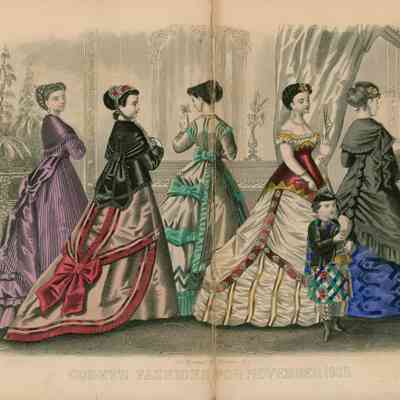
Godey's Fashions for November 1868
Fashion plate depicting five women and a child. The first woman, viewed from the back, is wearing a purple, pinstriped dress with levels of frills and puffs at the bottom of the skirt. A purple ribbon sash with streamers ending in tassels is at the waist. Around her shoulders, a matching shawl. The second woman, viewed from the back, is wearing a tan dress with red, ruffled trim and a large red bow at the back of the skirt. She is also wearing a black jacket with black lace trim and a bow at the back. On her head, a lace cap with red flowers. The third woman, viewed from the back, is wearing a white dress with green bows down the center back and green ruffles at the sleeves, hem, and side panels. Two rows of green zig-zags sit above the ruffled hem. The fourth woman is wearing a white dress with short, puffed sleeves and wide, square neckline. The skirt and bodice are both ruched and trimmed with gold. Along the overskirt, a thick red border with white daisies. Starting under the bust and ending below the hips, a red overlay with a dagged gold border. The child is wearing a black bolero, a tri-color kilt, and harlequin-patterned stockings. On the child's head, a black cap with a plaid triangle at the crown. In the child's hands, bagpipes. The fifth woman, viewed from the back, is wearing a blue dress with a side-ways arch pattern along the bottom of the skirt. Overtop, a long, black jacket with ruffles at the hem and at the shoulders. The back of the jacket is ruched and pulled up by a line of tabs down the center.

Godey’s Fashions for August 1864
“Godey’s Fashions for August 1864” - 5 ladies on terrace overlooking water and cliffs; one wears a sheer blouse and a Swiss belt; another a red jacket with points. A little girl wears a green jumper.

Godey’s Fashions for October 1864
“Godey’s Fashions for October 1864” 5 ladies and a girl. One admires herself in a riding habit, one in morning dress, others in day wear; girl in blouse and bolero or zouave jacket which matches her skirt.

Gown, Long
Entirely hand-stitched infant long gown made of fine white lawn, semi sheer; embroidered with Ayreshire style eyelet work. Fairly high waist made as a casing for a 1" silk ribbon, still present. The ribbon is now a pale cream color, with delicate brocade geometric design. The long, somewhat narrow skirt exhibits no seams except near the hem; apparently a seam was worked into both of the long lines of embroidery down each side front. The hem double-scalloped with eyelet borders and floral sprays; the bodice has a small floral motif with triangular center panel, and a field of eyelets. Edging across the neck, waist, and panel made of rows of French knots. Short raglan sleeves with triangular panel on top.
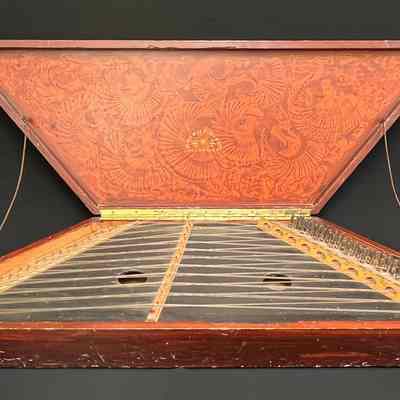
Hammered Dulcimer
One hammered dulcimer, sometimes called a hammer dulcimer, constructed from painted pine in a trapezoidal case. Painted and grained on inside cover in flowing shell designs. The case is hinged with two cords on each side to keep the propped open. On the left side there are 12 sets of 4 raised iron pegs alternating with 11 sets of 2 iron pegs. The side panels have a clear finish, as do the flank and the sounding board. An iron rod is inset on the edge of the left maple panel and protects the wood from the strings. There is a black painted sounding board with two circular resonator holes. One bridge, pierced with circular holes, is glued almost perpendicular to the front. Another is on the far right. The following words are stenciled in gold on the underside of lid: “P. Wight, Maker / Alabama, NY ". Includes 2 hammers and one tuner.
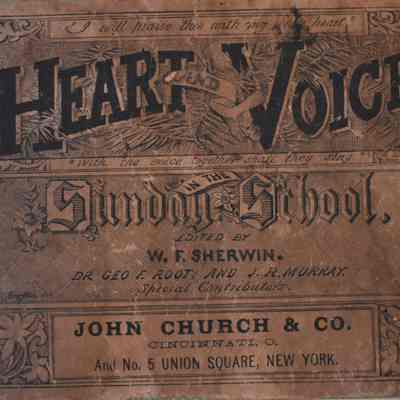
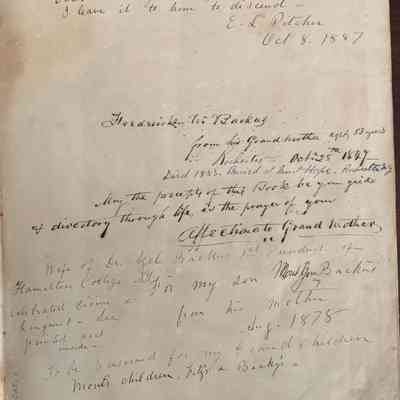
Holy Bible
Old and New Testaments; Apochrypha; Tables of measures and weights; Alphabetical table of proper names; and Concordance. Four illustrations (engravings): Tower of Babel, Shunamites Son Restored, The Wise Men's Offering, Christ's Agony. Physical Description: Embossed leather cover has floral design and a center oval with open book and fl
Holy Bible, The
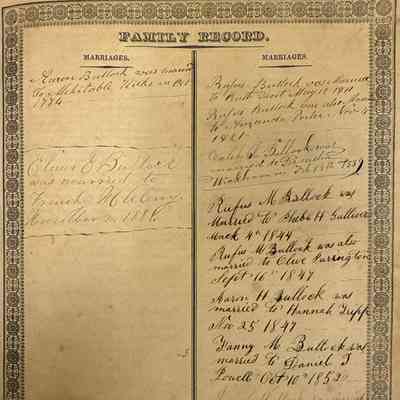
Bullock family Bible containing the Family Record recording the births, marriages and deaths spanning the years 1774 to 1935.
Idle Jenny
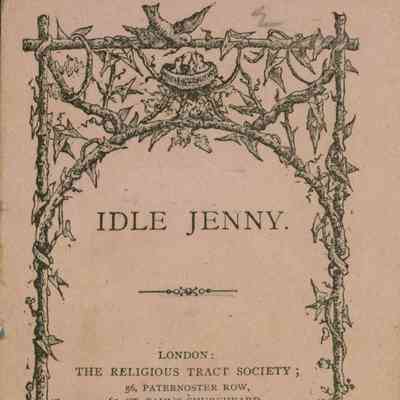
Children's book with a pink paper cover.
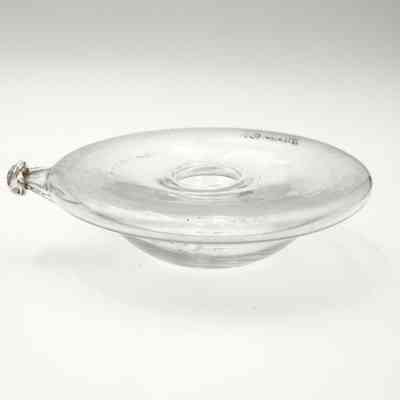
Infant Feeder
Clear glass, blown, baby feeder. Circular glass with an opening in the top with a mouthpiece for feeding.

Infant Shirt
Fine hand-stitched diamond-patterned linen toweling. Wide flaring shape, elbow-length tubular sleeves finished with narrow lace. A double row of lace insertion at the shoulder. Drawstring in the casing around the neck.

Infant's Gown
Infant’s long dress, entirely hand stitched fine white cotton. Smooth front skirt, gored at sides with very shallow, wide bodice. Very narrow linen PW tape drawstrings in waist casing in back form gathers in skirt. Casing, etc., in back neckline. Very narrow shoulder ‘strap.’ Short sleeves held in puffs by 3 vertical rows of Ayreshire insertion. Same insertion forms horizontal bands in F bodice between rows of extremely narrow tucks. 2 similar bands at hems; bodice, hem and sleeves edged with similar Ayreshire. Astounding quality of stitching.

Infant's Gown
Entirely hand-stitched infant’s cooler made of fine white cotton. Smooth front with no waistline; gored sides. The casing forms a high waist in the back. Wide shallow scooped neckline with narrow hem forming casing in back. Fine PW linen tape drawstrings. Short raglan sleeves edged with tiny rikrak made of tape. 5” hem with a double row of rikrak insertion, edged with a .5” band of fabric. Triple row of insertion down sleeve top, between rows of extremely fine pin tucks. 18” center front neck hem to bottom edge.

Infant's Gown
Long white cotton dress. Short sleeves with ruffles on the ends. Cut out embroidered bodice. Adornments on sleeves.
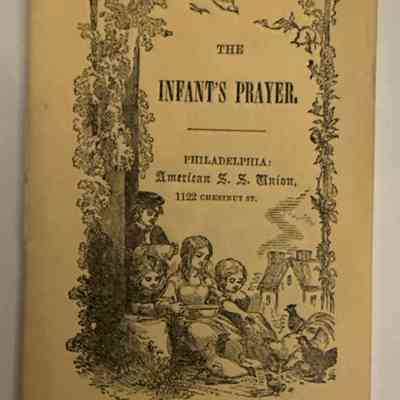
Infant's Prayer, The
Small 16-page Sunday School tract.
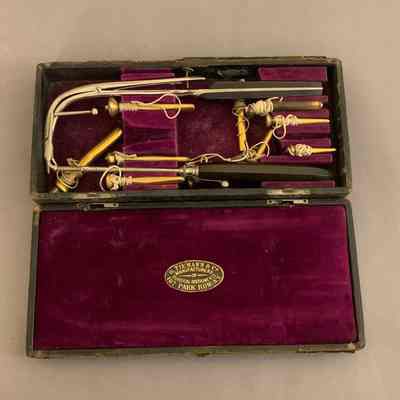
Intubation Kit
Intubation cased kit. Extraction tool (2023.01.002c) - makers mark from George Ermold, NY. c.1870 Insertion tool (2023.01.002d) - makers mark from George Tiemann & Co. Intubation tubes (2023.01.002e-n) Used to open airways in children. Often used with Diphtheria patients.
James G. Vail Diary, 1871
1871 diary of James Gardner Vail. There are a few entries by Vail including January 11 when Ella L. Wilkin began working in his gallery. He mentions paying her on serval occasions, an average of $2.50 very week or week and a half. A large portion of the diary was used at a later date, with the latest date being 1889. The pages were used to record the marriages of Libbie Boughton Vail's sisters. Laura Boughton married Frank C. Thompson on September 15, 1887. The passage details the wedding party, her dress, the dinner served, the guest list and the gifts received. The same information is recorded for Carrie Boughton's marriage to Elias Root on October 16, 1889. There is an extensive Boughton family history outlined by Rev. C W Backus and details on all of Libbie's siblings.

Journal des Demoiselles No III
Fashion plate depicting a girl in a dark red dress and mantle with an ermine muff and a wide-brimmed white hat with a red ribbon, a day cap with green adornment, a day cap with blue adornment, two sleeves with green ribbon, one sleeve with yellow ribbon, and two chemisettes with blue ribbon.
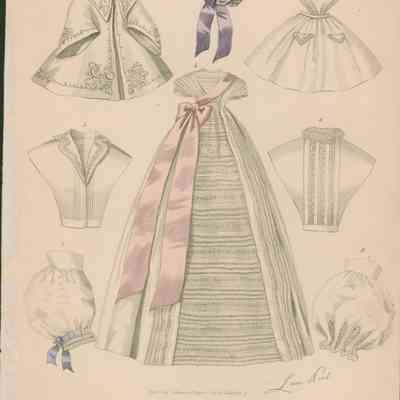
Journal des Demoiselles, August 1861
Fashion plate depicting children's clothing and various accessories. At the center, a long infant gown with rows of elaborate frills at the sides, collar, sleeves, and down the front. A pink ribbon sash crosses the body over the wearer's left shoulder. Top left, a child's white coat with black braid scrollwork. Top center, a black net snood with purple ribbons and pompoms. Top right, a child's apron with frills along the pocket flaps and bretelles. At the sides, two women's chemisettes and two full undersleeves.
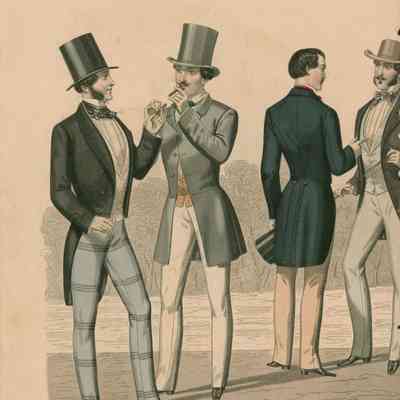
Journal des Marchands-Tailleurs, June 1853
Fashion plate depicting six men and one boy. The first man is wearing a black tailcoat with a white embroidered waistcoat and light blue pantaloons with bands of black stripes. Around his neck, a black cravat. On his head, a black top hat. The second man is wearing a grey frock coat with a melon-colored, embroidered waistcoat and white pantaloons. On his head, a grey top hat. The third man, viewed from the back, is wearing a black tailcoat over tan pantaloons and a red cravat. In his hand, a black top hat. The fourth man is wearing a black morning coat over a pale grey waistcoat and pantaloons. Around his neck, a blue plaid cravat. On his head, a tan hat. The fifth man is wearing a black frock coat with black pantaloons and a white cravat. The boy is wearing a grey spencer with a white shirt, pink plaid skirt, and white pantalettes with embroidered, dagged edges. On his head, a straw hat with a white band. The sixth man is wearing a black frock coat with a maroon waistcoat and pale blue pants with bands of black stripes. Around his neck, a green cravat.
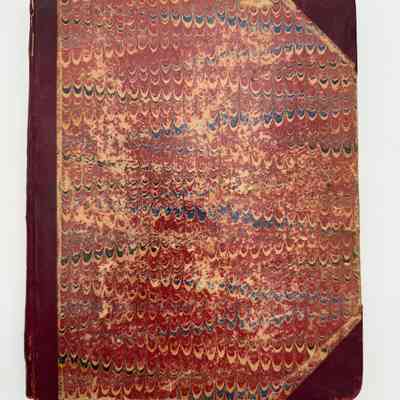
Journal of Mary M. Whitney, 1896-1904
Red and blue Marbled cover with maroon spine. Written inside are Mary's thoughts and excerpts from stories she's read and sermons she heard in church. Some loose paper throughout the book with notes and cut outs of news articles. Only about a third is written in.

Lady and Six Children in a Garden
Woman with 6 children in a garden. She wears a green and white banded dress with a basque bodice and pagoda sleeves. First girl wears blue tiered skirt with a hint of fancy pantalette showing; green bonnet. Little girl in blue pinafore dress over a blouse, more pantalette on view. Next girl in pink skirt with 3 rows of fringed black net, bretelles to match; white blouse. Toddler seated in elaborately embroidered, frill dress with blue bows and boots. Lad in blue jacket with basque, grecian meander trim. Peaked cap; pantelettes also on view. Last girl show back of dark silk bodice with long pleated basque over enormous two-tiered skirt with hint of pantalette showing, green boots, pink bonnet with black lozenge pattern.
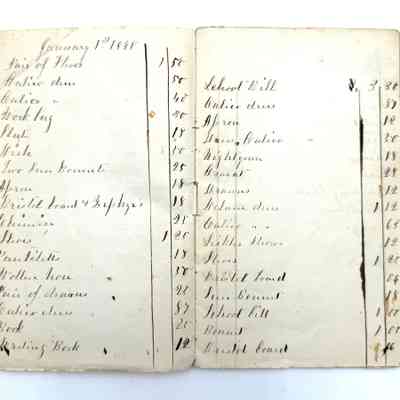
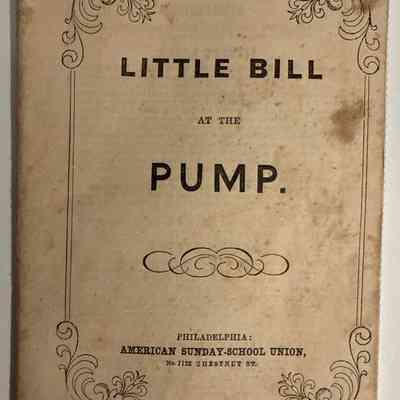
Little Bill at the Pump
Small 36-page Sunday School tract.

Livingston Park Seminary Anniversary Week Program, June 13, 1865
One Anniversary Week program for the Livingston Park Seminary, commencing June 13, 1865. This trifold program includes several days of class examinations, a musical review, and exercises by the graduating class.
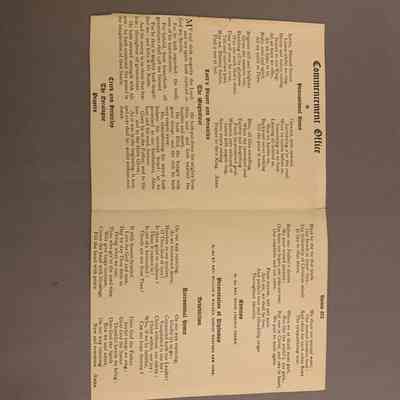
Livingston Park Seminary Commencement Ceremony Program
Program of a commencemnet ceremony for the Livingston Park Seminary. Possibly from the 1917 graduation.
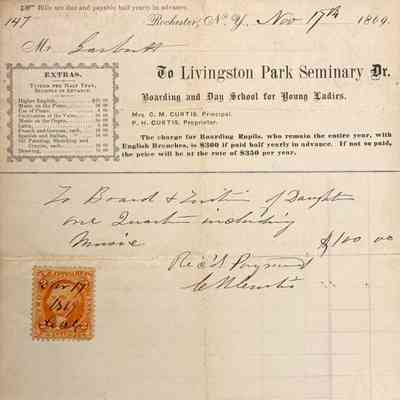
Livingston Park Seminary Receipt
One receipt to Mr. Garbutt from the Livingston Park Seminary in Rochester, NY. for the boarding and tuition of his daughter for one quarter, including music, $100. November 17th, 1869.

Livingston Park Seminary Receipt
One receipt to Mr. Hiram Dunn from the Livingston Park Seminary in Rochester, NY. for the boarding of his daughter. Additional coasts include vocal lessons and use of the piano. February 13, 1871.
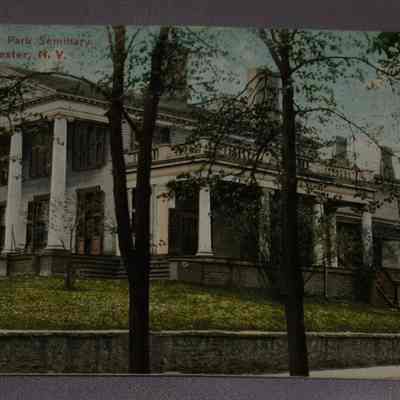
Livingston Park Seminary Rochester NY
One real photo postcard with color (not color photography) of Livingston Park Seminary in Rochester, NY. The angle is from the side and shows the front porch, the side porch, and the rear wing with porch.The back side has a green, one cent postage stamp with the head of Benjamin Franklin and a cancellation stamp of Rochester, NY, August 28, 1908. A short note with pleasantries and describing an unnamed hotel in Rochester. The publishing information printed on the back is: "A 7808 Published by The Rochester News Company, Rochester N. Y. U. S. A., / Made in Germany."

Livingston Place
One stereograph of Livingston Place, NY. The photographs are mounted onto yellow cardboard. The stereograph is part of the series "American Scenery."

Medical Bag
An alligator skin doctor’s bag. The bag has latches made of brass and a carry handle also in alligator. There is a brass plate on the front that is inscribed “Dr. J. Perry Horle.” The inside of the case has several compartments. One side has a removeable insert that holds eleven glass vials with corks and identified by paper labels. The back of the insert is covered in brown leather and has a pocket for papers and such. Behind this insert is space for an additional eight vials. On the other side of the case is space for eleven more vials. Underneath the vials is a compartment with a door made of brown leather and lined with purple velvet. Inside is a brass syringe and parts of a syringe. This bag was owned by Dr. John Perry Horle (1868-1927) of Fly Creek, NY.
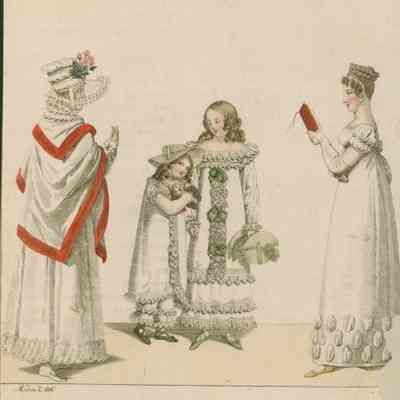
Moden Z. 1816
Fashion plate depicting two women and two girls. The first woman is in back view, wearing a white dress under a square shawl with a red border. On her head, a white bonnet with a sheer brim and ruffles around the edge. Both girls are dressed similarly in white dresses with lace decorations down the front, though the girl on the right has long sleeves and is adorned with green ribbons. The second woman is wearing a simple white dress with puffed sleeves and ruched ovals above the hem.
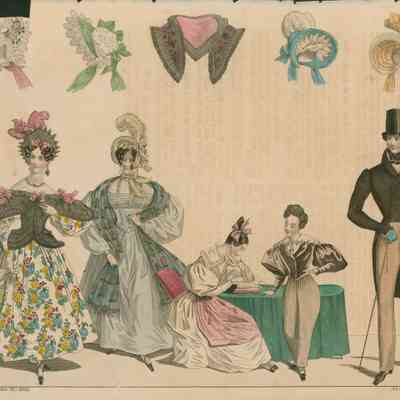
Moden Z. 1833 No. 41
Fashion plate depicting a woman in a floral-printed dress with a black pelerine and pink-plumed black bonnet, a second woman in a pale blue dress with a blue calico shawl and white bonnet, a girl wearing a white dress with a pink apron, a boy wearing a black spencer over tan trousers, and a man in a black tailcoat with tan trousers. Above them, a lace day cap with pink ribbons, a day cap with green ribbons, a black lace shawl with pink lining, a blue bonnet with plumes, and a yellow bonnet with frills.
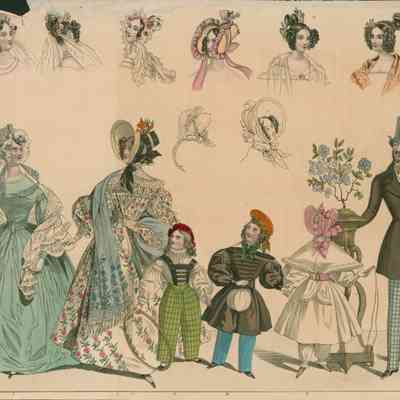
Moden Z. 1836, No. 28
Fashion plate depicting two women, two boys, one girl, and one man. The first woman is wearing a blue day dress and a white lace shawl. On her head, a white day cap with blue ribbon. The second woman is wearing a white day dress with floral print and a blue, fringed shawl. On her head, a straw bonnet with black ribbons and red flowers. The first boy is wearing green plaid trousers and what appears to be a harness of sorts. On his head, a red cap. The second boy is wearing a black frock coat with gigot sleeves over blue striped trousers. On his head, an orange hat with green accents. The girl is wearing a white dress with a white pelerine that has been tucked into a pink belt at the waist. On her head, a pink bonnet. The man is wearing a brown frock coat over blue plaid trousers and a yellow plaid cravat. On his head, a pale blue top hat. Above them, the heads of eight women. Two are in veils, one is in a lingerie cap, one is in a straw bonnet with pink ribbons, and two are wearing elegant, curled coiffures. The final two are wearing bonnets and are uncolored.
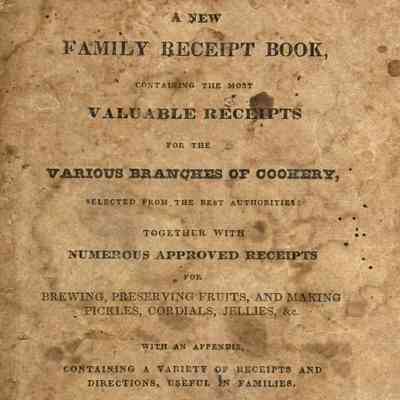
New Family Receipt Book, A:
Includes recipes for deserts, for preserving fruits, vegetables, nuts, making sauces, cordials, jellies, ice cream, syllabub, wines, condiments, brewing beer, etc. plus an appendix containing advice for good health, transplanting trees, preserving flowers, making ox gall, cleaning silks, woolens and cottons, cleaning carpets, removing stains, dental health, healing cuts and bruises, curing piles, making Beef Tea, etc.
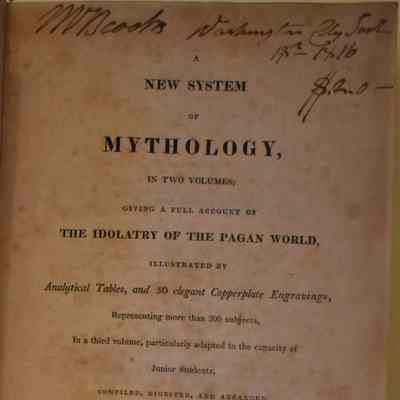
New System of Mythology, A
In two volumes; giving a full account of the idolatry of the pagan world, illustrated by analytical tables, and 50 elegant copperplate engravings, representing more than 200 subjects, in a third volume, particularly adapted to the capacity of junior students, compiled, digested, and arranged, by Robert Mayo.
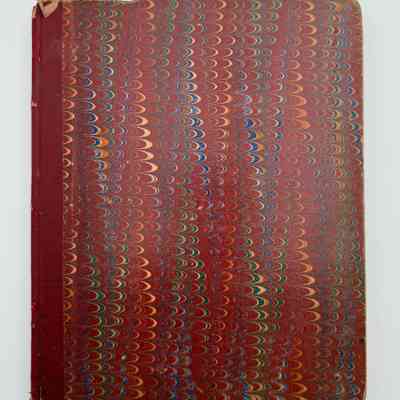
Notebook, Sadie Alvina Cole
Notebook of Miss Sadie Olivia Cole, a student of the Livingston Park Seminary, Rochester, NY. April 16, 1888 - June 1888.
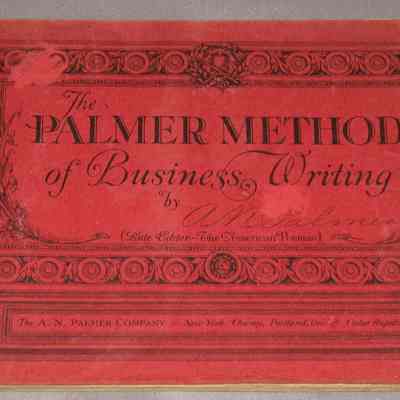
Palmer Method of Business Writing
"A series of self-teaching lessons in rapid, plain, unshaded, coarse-pen, muscular movement writing for use in all schools, public or private, where an easy and legible handwriting is the object sought; also for the home learner." -- quoted from inside front cover of book Physical Description: Red paper cover

Penmanship/Drawing Exercise
One watercolor/penmanship exercise of nautilus/shell in shades of brown.

Penmanship/Drawing Exercise
One watercolor/penmanship exercise of a blue bird sitting on a branch with green leaves and red and yellow flowers.

Penmanship/Drawing Exercise
One watercolor/penmanship exercise of red, orange, yellow, brown, and green maple leaves on a branch.

Pinafore
Entirely machine-stitched large pinafore. ‘Bubble’ stripes. Flared, side seams, Wide neck. Bound hems (polka dots). Shaped sleeves with tucks. 3 missing buttons.
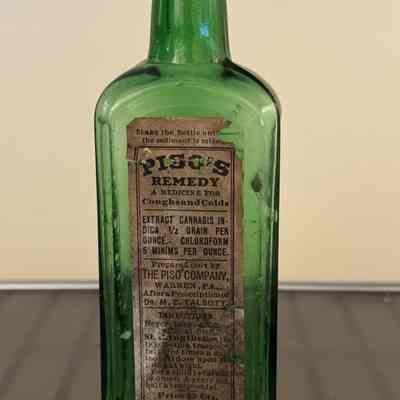
Piso's Remedy Bottle
1 green four panel bottle with neck and no stopper; front panel has paper label stating "PISO'S REMEDY. A MEDICINE FOR Coughs and Colds. EXTRACT CANNABIS INDICA 1/2 GRAIN PER OUNCE. CHLOROFORM 5 MINIMS PER OUNCE. Prepared only by THE PISO COMPANY, WARREN, PA. After a Prescription of DR. M. F. TALBOTT."; back panel has embossed in glass statement "THE PISO COMPANY." Right side panel is embossed with "HAZELTINE & CO."; left side panel is embossed with "TRADE - PISO'S - MARK."
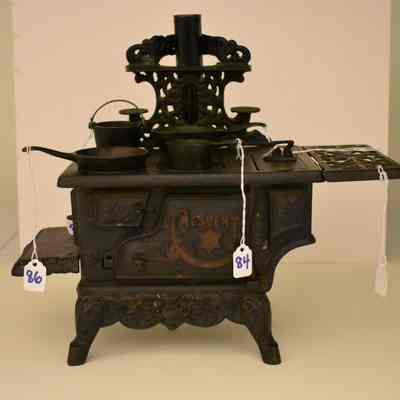
Play Kitchen
Small cast iron toy stove.

Portrait of Mary Ann Dillon Thurstone
Portrait of a young girl (Mary Ann Dillon)wearing a blue dress with short puffed sleeves. She has brown hair and eyes and is wearing a coral beaded necklace and holds an apple in one hand, and a black woven purse with blue accents in the other. Green foliage in the background. Mounted in a gold frame.